Sign up today

Sign up today
Softphone APP for Android &IOS

RG Richardson Communications News

I am a business economist with interests in international trade worldwide through politics, money, banking and VOIP Communications. The author of RG Richardson City Guides has over 300 guides, including restaurants and finance.

Hollywood hates the fake clip of these guys fighting


Tom Cruise and Brad Pitt smile and clasp their hands

Karwai Tang/Getty Images

An AI-generated video of Tom Cruise and Brad Pitt beating each other up on a rooftop went viral this week, and it could be confused for a real movie scene—until you hear Pitt’s likeness say, “You killed Jeffrey Epstein.” Still, it was convincing enough to scare at least one screenwriter.

“It’s likely over for us,” Deadpool franchise co-writer Rhett Reese posted on X in response to the 15-second clip. It was created using Seedance 2.0, an AI video tool owned by ByteDance that was unveiled this week.

Then…the Motion Picture Association (MPA) released a statement accusing ByteDance of violating copyright law on a “massive scale.” SAG-AFTRA joined in yesterday, calling Seedance videos “blatant infringement.” Oopsie:

  • Seedance appears to be producing videos that rip off protected works from studios including Disney, Warner Bros. Discovery, and Paramount, Deadline reported.
  • Eerily accurate knockoffs of beloved movie characters like Jack and Rose from Titanic, Spider-Man, and Shrek appear in other Seedance videos circulating online.

Déjà vu: The MPA similarly urged OpenAI to curb copyright infringement after it launched the Sora 2 video generator last fall. OpenAI obliged, and Disney later struck a deal that allows Sora 2 to use some of its characters. It’s unclear if Hollywood would pursue a similar agreement with ByteDance, which is a Chinese company.

Cuba is facing an economic and social catastrophe, and not entirely because of Donald Trump

Cuba is facing an economic and social catastrophe, and not entirely because of Donald Trump

Cuba is facing an economic and social catastrophe, and not entirely because of Donald Trump
Published: February 12, 2026 9.02am EST


Author
Robert Huish

Associate Professor in International Development Studies, Dalhousie University
Disclosure statement

Robert Huish receives funding from the Social Sciences and Humanities Research Council of Canada
Partners

View all partners
DOI

https://doi.org/10.64628/AAM.pvqhpjgdt

We believe in the free flow of information
Republish our articles for free, online or in print, under Creative Commons licence.Republish this article

If you’re planning on a winter break to Cuba, get ready for an adventure rather than a vacation. If you’re wondering if United States President Donald Trump’s oil embargo will shatter Cuba’s Communist government, dig in for a drawn-out slog. And if you’re Cuban, brace for a nightmare.

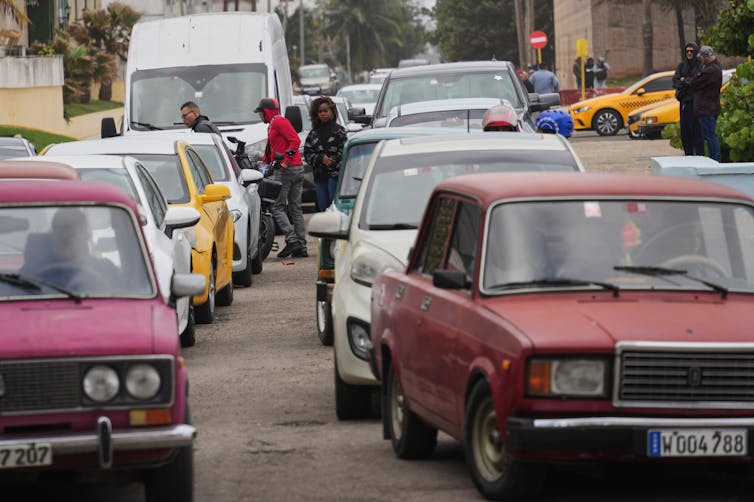
Cuba is on the brink of one of the worst social and economic catastrophes since the 1959 revolution. Energy sources are sparse. The electrical grid is in tatters.

Inflation is over 15 per cent, with the peso tumbling in value. Tropical diseases like dengue, chikunguny and Oropuche virus are surging, largely because the municipal waste system in Havana ground to a halt in 2025.

As many as two million Cubans have left the country since 2021. Infant mortality spiked from five per 1,000 live births in 2021 to 14 per 1,000 in late 2025.

And now, revenue streams from tourism, international medical co-operation and pharmaceutical production are all but dried up. Some 5,000 Cubans volunteered as mercenaries to fight alongside Russia against Ukraine since 2022. Cuba is hurting.
Drivers wait in line to fill up at a gas station in Havana, Cuba, Jan. 27, 2026. (AP Photo/Ramon Espinosa)
The U.S. versus Cuba

Cuba’s current pain may not be enough to topple its Communist government, despite the desires of many Cuban exiles. Nor is the current crisis all Trump’s work. Cuba is a victim of the breakdown of the old international rules-based order.
Start your day with evidence-based news


Subscribe
This site is protected by reCAPTCHA and the Google Privacy Policy and Terms of Service apply.

Read more: Venezuela attack, Greenland threats and Gaza assault mark the collapse of international legal order

The U.S. has long targeted Cuba through various economic weapons dating from the early 1960s. One of the most vicious was the Helms-Burton Act that not only prohibited U.S. companies from doing business with Cuba, but also punished companies in other countries for dealing with both Cuba and the U.S.

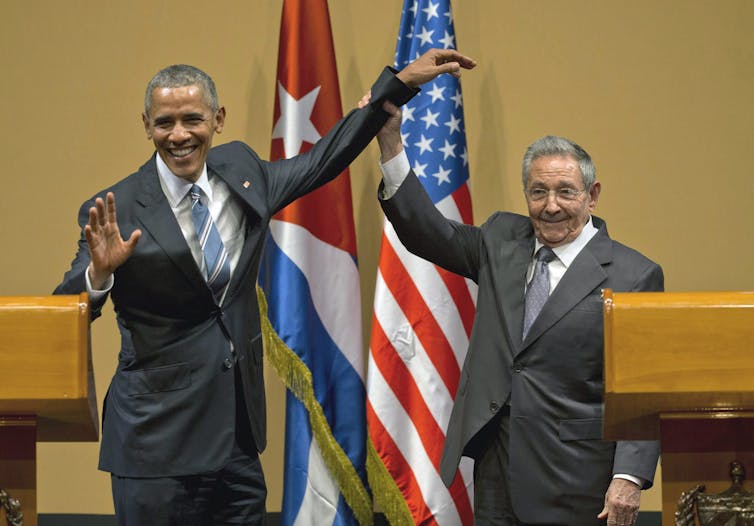
In his second term, U.S. President Barack Obama eased travel restrictions for Americans visiting Cuba along with some trade policies, but this was short-lived. Trump restored these measures in his first administration.
Cuban President Raul Castro, right, lifts up the arm of U.S. President Barack Obama, at the conclusion of their joint news conference in Havana, Cuba, in March 2016. It was the first visit by a sitting U.S. president to the island nation in 88 years. AP Photo/Ramon Espinosa, File)
Cuban doctors

For decades, Cuba relied on an elaborate network of international solidarity and co-operation with rich and poor countries alike. More than 100,000 Cuban doctors served abroad, often providing medical care in rural and remote locations.

While Cuban doctors working abroad received a salary bump, the government received handsome cash deposits and preferred trade agreements for select products. Venezuela received tens of thousands of Cuban doctors and, later, security personnel in exchange for heavy petroleum.

Read more: Big Pharma vs. Little Cuba: Why Cubans trust vaccines and how they’re helping vaccinate the world

Cuban doctors served in 103 countries, and as of 2021, they were active in 69 nations. Agreements were also made for other personnel to work abroad, including athletic coaches, teachers and engineers.

The U.S. targeted Cuba’s international solidarity work in 2006 by creating the Cuban Medical Professional Parole program, which essentially regarded Cuban workers as “trafficked.”

The State Department approved an annual US$10 million budget until 2017 to locate and recruit Cuban and Cuban-trained doctors working in poor areas of Latin America and Africa. Diplomats offered them expedited immigration to the U.S. But upon arrival, many had their medical credentials ignored and wound up unemployed or underemployed.
Global support

Against one of the longest economic blockades in history, Cuba has nonetheless positioned itself as an active global player. It’s a diplomatic heavyweight with 139 active embassies and consulates worldwide and well over 100 foreign embassies in Havana.

The United Nations General Assembly routinely denounces the American embargo on Cuba. In 2025, amid shifting political alliances, the assembly voted 165-7 in favour of demanding an end to the embargo.

Many international partnerships have kept Cuba going through hard times in the past. Canada, Italy and Mexico, in particular, have kept business with Cuba going despite the U.S. embargo. In the 1990s, tourism expanded, notably from these countries, helping to stimulate the Cuban economy.
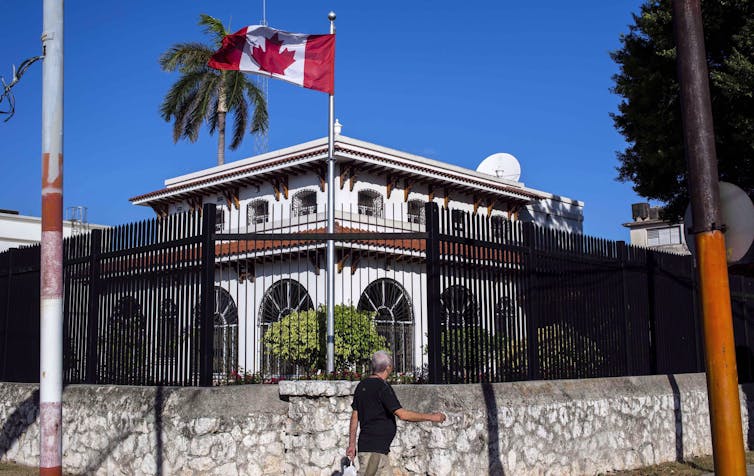
The Canadian embassy in Havana in 2018. THE CANADIAN PRESS

Canadian mining company Sherritt invested heavily in Cuba to extract nickel. When COVID-19 overwhelmed health systems worldwide in 2020, Cuba was the first to volunteer medical services to 19 countries, including affluent states like Italy and Qatar. They even took in a quarantined British cruise ship to offer care.

Read more: The scene from Cuba: How it’s getting so much right on COVID-19

But in 2026, countries are sending in aircraft to evacuate their vacationing nationals, and companies like Sherritt are grinding to a halt, not because of the U.S. embargo, but because so many professionally trained Cubans have emigrated.

Unlike the 1960s and the 1990s, no brave partners are coming forward to do business with Cuba, which only shows how weak international solidarity is today.

Here are three possible outcomes for Cuba in the coming months in descending order of likelihood:
1. Deals behind the scenes

A backroom deal could be struck between Trump’s White House and Miguel Díaz-Canal’s government in Cuba in much the same way that the Obama administration struck deals with Raúl Castro’s government, working through the Vatican and Canadian diplomats. For example, the Trump administration could permit fuel to be purchased in cash from the U.S., or more tourist real estate may be opened to foreign ownership.

If any deal is in the works, the sticking point will be elections. Unlike Venezuela, with a legitimate opposition in the wings, Cuba has none. Political opponents to the revolution have long been jailed or exiled, and Cuba’s electoral system itself isn’t structured for a multi-party race. Toppling the current government would leave an enormous power vacuum.
2. Martial law

If the fuel embargo remains, Cuba could declare martial law and civil defence to prepare for foreign hostility and to better ration resources.

Díaz-Canal recently hinted at this in what he calls a “war of the people,” which may help explain why Canadian and Russian airlines are now hastily sending in rescue flights for tourists.

Martial law would mean ultra-tight rationing, political volatility and the government acquiring goods through murky channels, which, combined, pose a heightened security risk to the U.S. just 140 kilometres off its shores. Since Dwight D. Eisenhower, most American presidents quickly figured out it was better to have a stable and secure, even though ideologically opposed, neighbour than a politically unstable and vulnerable basketcase.

The situation will grow dire since the well-educated professional class has already left, along with many doctors and nurses. In past crises, the educated, youthful professional class was on hand; this time, they’re already gone.
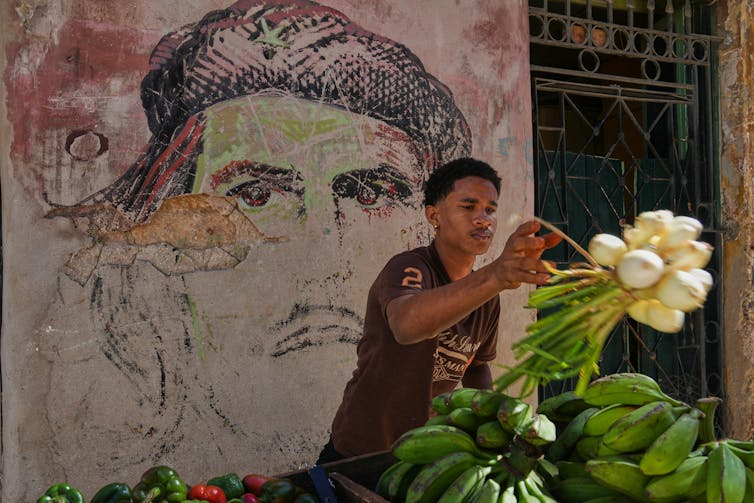
A vegetable vendor prepares onions for sale on his cart near an aged mural of Ernesto ‘Che’ Guevara in Old Havana, Cuba, in January 2026. (AP Photo/Ramon Espinosa)
3. The international community steps in

Third, the world could stand by its sentiment at the United Nations General Assembly and sends much-needed resources and trade to Cuba despite the U.S. bellicosity.

It could be a rallying point for the new era of international order, where bullied countries in the Americas and in Europe defy American pressure and bring lifelines to Cuba.

Read more: Mark Carney’s Davos speech marks a major departure from Canada’s usual approach to the U.S.

International solidarity could reverse some of the harm and take the pressure off Cubans, including those so desperate they’d choose to fight as mercenaries with Russia.

As the world has seen before, when nations stand up to Trump, he usually backs down. Assistance need not come through foreign aid, but simply by keeping the channels open for business.

But if the international community ignores Cuba today, a humanitarian nightmare will unfold soon.

The AI warnings are coming from inside the house


AI spark icon on fire, in a simple cartoon-y style.

Shannon May

It’s as if a bunch of AI experts just had the same nightmare, because this week, several of them—including ones at Anthropic and OpenAI—seemingly jolted upright in a cold sweat to speak on the horrors they see coming from artificial intelligence.

Anthropic: The company behind Claude lost its head of Safeguards Research, who announced his resignation in a letter that mentioned a world “in peril.” Speaking vaguely about Anthropic, he wrote, “Throughout my time here, I’ve repeatedly seen how hard it is to truly let our values govern our actions…we constantly face pressures to set aside what matters most.”

At OpenAI, alarm bells came from three different employees this week:

  • A researcher quit after two years due to “deep reservations” about ChatGPT’s new ad strategy, namely “a potential for manipulating users,” she wrote in an essay for the New York Times.
  • A top safety executive was fired after opposing the upcoming release of AI erotica on ChatGPT, the Wall Street Journal reported. OpenAI said she was canned for sexually discriminating against a male coworker, which she called “absolutely false.”
  • In a post on X that alluded to widespread job loss, an engineer wrote, “I finally feel the existential threat that AI is posing.”

HyperWrite: The co-founder of an AI writing tool startup warned in a viral post on X that the latest AI models will render countless jobs obsolete, comparing the current moment to the weeks before the Covid-19 pandemic.

How about some AI restrictions for the table?

OpenAI and Anthropic are of two minds on how much to regulate their industry:

  • Anthropic pledged $20 million to a political group that backs congressional candidates who favor AI safety, the company announced yesterday. (That’s substantial, but the company also announced yesterday that it closed a $30 billion fundraising round that valued it at $380 billion.)
  • OpenAI has supported Leading the Future, a pro-AI super PAC that spends against the types of candidates that Anthropic’s donation would help.

Meanwhile…half of xAI’s founders have exited as of this week, though the recent departures didn’t specifically cite AI concerns.

Quebec upholds tuition hikes as Concordia braces for deeper budget cuts


Quebec upholds tuition hikes as Concordia braces for deeper budget cuts
Students, universities warn higher fees increase financial pressures and lower enrolment

NewsMatthew Daldalian — Published February 10, 2026 minutes
Quebec is maintaining a 33 per cent tuition hike for out-of-province students attending English-language universities. photo Naya Hachwa


The Quebec government is maintaining the tuition hikes for out-of-province students attending English-language universities, confirming that the increased fees will remain in place following the province’s revised funding framework.

The decision preserves a roughly 33 per cent increase that raised the minimum tuition for out-of-province Canadian students studying in English to about $12,000 annually, up from $9,000 in Winter 2024.

“When I was applying to come here, it was my first choice, but because of the tuition hikes, it made me reconsider everything,” said Kalia Graham, a second-year psychology student at Concordia University, originally from Whitehorse, Yukon. “I almost didn’t end up coming.”

The tuition hike was first announced in October 2023 as part of a broader overhaul of Quebec’s university funding system targeting English-language institutions.

English universities initially challenged the increase in court. However, the province has since updated its rationale, arguing that the increase prevents Quebec taxpayers from subsidizing the education of non-resident students.

“I had to really discuss budgeting with my family and plan it out to see how it would look,” Graham said.
Graham added that two of her friends who had also planned to attend university in Montreal ultimately chose not to because of the tuition increases.

These provincial policy changes have also had institutional consequences. Concordia and McGill University previously argued in court that the tuition overhaul harmed their competitiveness and contributed to declining out-of-province applications, forcing budget adjustments and service reductions.

According to remarks delivered during recent Concordia Senate discussions on Feb. 6, the government has now formally entrenched the higher fee, arguing that it is “not fair for the taxpayers of Quebec to be subsidizing the cost of educating students from elsewhere.”
“There comes a point where you get used to the fact that people consider you to be the easy scapegoat.”— Thang Tran, international student

Senate discussions also noted that students studying in French-language programs continue to pay the lower rate, meaning the financial impact disproportionately affects English-language institutions.

Ryan Assaker, finance coordinator for the Concordia Student Union, said the consequences are already visible on campus.

“We’ve seen trends here where the free food programs that we have are having bigger lines," Assaker said, pointing to increased demand for student services. "The housing [services], or all of our service departments, are also ranking up.”

Financial strain is also reflected in campus reductions, Assaker said, including cuts to limited-term appointment teaching positions—short-term instructors hired to teach specific courses—as well as reduced shuttle-bus service between campuses.

Assaker added that declining international enrolment could have long-term effects on programming and staffing.

“The incentive isn’t there anymore," he said. "It’s costing too much."

For students already enrolled, the issue is not only future costs but also uncertainty about how policies apply.

Senate discussions have highlighted concerns that some out-of-province students who switch programs risk losing their original tuition status, potentially facing the higher rate even if they began their studies before the policy took effect.

Adam Semergian, academic coordinator for the Arts and Science Federation of Associations, said student groups are already hearing concerns about enrolment decisions.

“We’ve heard from current students that their family members [...] are not planning to come to Concordia now because of the tuition hike,” Semergian said. “It’s 33 per cent now, but what about in the future?”

Despite the higher costs, some students say they remain committed to continuing their studies in Montreal while navigating financial pressures.

Graham said her budgeting now depends on summer work, grants and loans, adding that she typically works multiple jobs during the summer months to cover expenses.

International students face similar challenges. Thang Tran, a first-year computer science student from Vietnam, said he has grown accustomed to the idea of higher fees but still feels the policy's financial and political implications.

“There comes a point where you get used to the fact that people consider you to be the easy scapegoat,” Tran said.

He added that as a non-citizen, he feels he has limited power to fight back against decisions affecting tuition.

The latest decision primarily confirms the 33 per cent tuition increase for out-of-province Canadian students; it does not affect international students.

However, this comes at a time when international students are already affected by earlier reforms that raised minimum tuition levels for English universities in Quebec.

In the meantime, university officials say they will continue raising concerns with the province.

In a written statement, Concordia deputy spokesperson Julie Fortier said the institution is “of course disappointed by the decision but not surprised,” adding that the university plans to discuss with Higher Education Minister Martine Biron how the policy harms the competitiveness of Quebec universities and contributes to declining applications.

Fortier noted the university continues to offer financial awards to help offset the higher tuition for out-of-province students.

For students like Graham, entrance scholarships and student-run services have helped ease the transition, although financial planning remains a constant concern.

For Tran, the issue ultimately comes down to the limited control many international students feel they have over policies that directly shape their education.

“There isn’t much I can do. I can’t really engage with democracy in a way that citizens can,” Tran said. “All I can do is tell my friends, 'Well, if you don’t like it, you should vote.'”

With files from Moon Jinseok