Sign up today

Sign up today
Softphone APP for Android &IOS

RG Richardson Communications News

I am a business economist with interests in international trade worldwide through politics, money, banking and VOIP Communications. The author of RG Richardson City Guides has over 300 guides, including restaurants and finance.

The violence and incitement are coming from Trump


The violence and incitement are coming from Trump

Words & Phrases We Could Do Without

Donald Trump twists language, as do all autocrats, to cast himself and his cult as victims, whereas his dissenters are violent, rebellious, and threatening. In the real world, however, we have seen Trump repeatedly provoke violence rather than take any measures to prevent it. Indeed, he has historically encouraged rather than condemned violent supporters.

The president deliberately confuses “violence” with “protest,” and “rebellion” with “demonstrations.” He insisted in his memorandum nationalizing the California National Guard and deploying the Marines that he holds the power to deploy forces anywhere in the U.S. where protests are or are likely to occur. He later threatened to use “heavy force” against protestors who showed up at his sparsely attended birthday parade.

This all feeds into a pattern. When Trump called for his mob to charge the Capitol on Jan. 6 or egged on the crowd chanting “Hang Mike Pence,” he was inciting violence. As Gov. Gavin Newsom remarked to Californians, “Trump—he’s not opposed to lawlessness and violence, as long as it serves HIM. What more evidence do we need than January 6th?” When Trump pardoned violent insurrectionists, he established an approval structure that encouraged other acts of violence (be they in MinnesotaUtah, or Culpepper, Va.)

When Trump sent Marines and the National Guard into a relatively calm city, that was “incitement.” He was spoiling for a fight to justify more repression and state terror against ordinary workers whom he has demonized and dehumanized. And when he vowed to step up raids of masked ICE agents in Democratic cities, he was threatening to incite more violence.

Trump consistently tries to use opponents’ imaginary violence to justify the use of force. However, U.S. District Court Judge Charles Breyer of the Northern District of California debunked the government’s claimed authority to deploy force in anticipation of a “rebellion”:

[T]he Court is troubled by the implication inherent in Defendants’ argument that protest against the federal government, a core civil liberty protected by the First Amendment, can justify a finding of rebellion. The [Supreme Court cases] are chock-full of language explaining the importance of individuals’ right to speak out against the government—even when doing so is uncomfortable, even when doing so is provocative, even when doing so causes inconvenience….

Applying these principles, courts have repeatedly reaffirmed that peaceful protest does not lose its protection merely because some isolated individuals act violently outside the protections of the First Amendment.

Breyer reaffirmed that preempting or preventing First Amendment expression on the speculation that violence might occur is verboten under the First Amendment. “In short, individuals’ right to protest the government is one of the fundamental rights protected by the First Amendment, and just because some stray bad actors go too far does not wipe out that right for everyone,” Breyer wrote. “The idea that protesters can so quickly cross the line between protected conduct and ‘rebellion against the authority of the Government of the United States’ is untenable and dangerous.”

Now, even core First Amendment speech is enough to set off a MAGA crackdown. MAGA authoritarians suggest the standard for use of force against peaceful Americans is so low that even “failing to show deference” to the regime is sufficient cause to trigger government violence, as the Department of Homeland Security claimed after manhandling Sen. Alex Padilla (D-Calif.) When the temerity of voicing dissent is sufficient to trigger a violent government crackdown, we should be clear which side has resorted to violence.

Trump appears “eager to create optics that support his claim that public dissent constitutes an existential threat to the nation,” writes Ruth Ben Ghiat. She adds that Trump, in true authoritarian style, uses various methods: “Flooding our screens with images that habituate us to a new reality of federalized state militia members standing opposite civilian protesters is part of it. So is mobilizing our armed forces for a parade staged on Mr. Trump’s birthday.” This is about intimidation, crushing dissent, and brute force. Trump’s characterization of protestors has nothing to do with their actual conduct, and everything to do with whether they are on his side. Whoever does not conform to his dictates is fair game for the strongman’s violence.

In sum, Trump has defiled ordinary language (“preventative,” “rebellion”). He mischaracterizes protests as “violence” or “riots,” and falsely adopts the mantle of “restoring law and order.” Those words have lost any semblance of meaning under his regime. Instead of adopting his descriptions, we must acknowledge that Trump actions fit the playbook of fascists, who instrumentalize violence to crack down on opposition. Trump wants to prevent dissent, and will use violence to accomplish his meansHe wants to provoke and incite a violent response, leaving him with justification to crush his opponents.

If that sounds like the death knell of democracy, it is. Thankfully, millions of people peacefully demonstrated on Saturday that they know what the First Amendment allows, and do not intend to let Trump get away with inflicting violence on our Constitution or brutalizing fellow Americans.
The Contrarian is reader-supported. You enable us to keep up the patriotic opposition—and to have fun along the way. To support our work and join our community of good troublemakers, please consider becoming a free or paid subscriber.

Employees are imprisoned in an ‘infinite workday


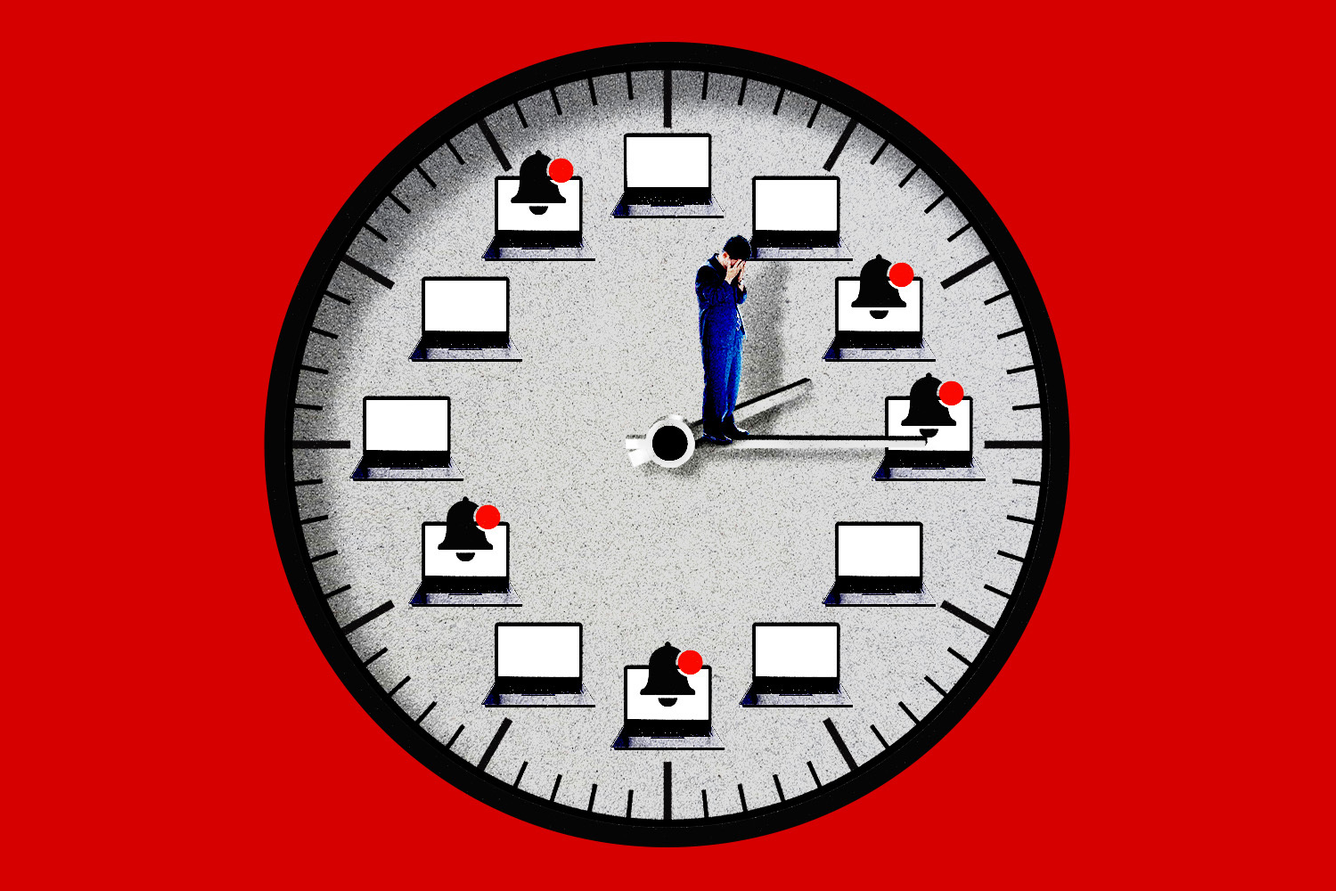
an illustration of a person in the middle of a clock surrounded by laptops with notifications instead of numbers

Illustration: Anna Kim, Photos: Runstudio/Getty Images, Adobe Stock

Workdays once had a defined beginning and end. But, much like a bad first date or a card game at a party, workdays are increasingly stretching on forever, per the latest data from Microsoft’s Work Trend Index Special Report.

The “infinite workday,” as Microsoft calls it, began as an anomaly with the rise of remote work during the pandemic but has since become the norm for many who are unable to disconnect completely. Microsoft made the observation after parsing “trillions” of data points across its Microsoft 365 products.

Brace for the soul-crushing numbers:

  • Early mornings: Microsoft used telemetry to determine that 40% of people online at 6am are checking work email instead of hitting the snooze. Meanwhile, Teams becomes the primary communication platform within the Microsoft environment by 8am, with workers receiving an average of 153 messages per weekday.
  • Midday: Half of meetings take place between 9am and 11am and 1pm and 3pm, right when people are at their most productive (due to circadian rhythms). And 57% of meetings occur without a calendar invite, while 1 in 10 are booked last minute.
  • Evenings/weekends: Meetings after 8pm are up 16% over last year, and the average employee sends or receives more than 50 emails outside of regular business hours. On weekends, ~20% of employees check work email before noon.

Got a minute? This might be the most staggering detail from the report: Employees using Microsoft 365 are interrupted by a meeting, email, or notification every two minutes during “core business hours,” and that doesn’t even include your coworker swinging by your desk to tell you about their fantasy football team.

AI could help (and also hurt). The report concludes that using AI for menial tasks will free humans to focus on more important aspects of their jobs. But as Forbes notes, if AI is only freeing people for more assignments, a healthy work-life balance will remain out of reach.—DL

Check out the Declaration’s list of grievances


Check out the Declaration’s list of grievances

It’s time to recapture our freedoms.

Desperate for some inspiration, I decided to reread the entire Declaration of Independence. We know it as an aspirational document (“We hold these truths…”). We understand it as a repudiation of tyranny (“Such has been the patient sufferance of these Colonies; and such is now the necessity which constrains them to alter their former Systems of Government.”). It is both those things, but it is also a compendium of complaints, a description of an autocrat’s offenses against a free people. And that was the part I found strangely relevant to our times.

The signers railed about exclusionary immigration policies that hurt the colonies (“He has endeavored to prevent the population of these States; for that purpose obstructing the Laws for Naturalization of Foreigners; refusing to pass others to encourage their migrations hither”). They inveighed against barriers to trade (“cutting off our Trade with all parts of the world”). And they condemned imposing “Taxes on us without our Consent,” which, if we remember that unilaterally imposed tariffs are a consumer tax, also sounds familiar. Tyrants, then and now, seek to dominate and micromanage commerce to the detriment of ordinary people seeking a better life.

And notice the common problem, then and now, when a tyrant attempts to corrupt the rule of law by seeking to intimidate and threaten members of the judiciary (“He has obstructed the Administration of Justice…. He has made Judges dependent on his Will alone, for the tenure of their offices”); seeks to impair due process (“depriving us in many cases, of the benefits of Trial by Jury”); and even ships people out of the country for punishment (“Transporting us beyond Seas to be tried for pretended offences”). The tyrant playbook has not changed much in nearly 250 years.

Using the military improperly has always been a go-to move for tyrants. “He has kept among us, in times of peace, Standing Armies without the Consent of our legislatures” (or in our case, the governor of California) and tried to make “the Military independent of and superior to the Civil power” (by, among other things, threatening to deploy them to silence protests). “Quartering large bodies of armed troops among us” is still going on in Los Angeles. And “He has excited domestic insurrections amongst us …”—or in Donald Trump’s case, incited violence, called it an insurrection and then used it as a pretext to send in the military.

Though our bill of particulars against Trump bears some resemblance to the Declaration’s list of grievances, it might be useful to include a few of Trump’s more recent offenses:

I could go on.

In a functional democracy with a vibrant, independent and conscientious Article I branch, the compendium of Trump’s offenses would serve as an outline for articles of impeachment. In the era of a pliant, quivering Republican House and Senate majority, the litany of horrors should at least highlight the degree to which Trump has tried to assume the powers of a king. (It’s no coincidence he flocks the Oval Office in gold—décor long favored by monarchs, tyrants, and real estate developers with bad taste.)

Nearly 250 years ago, after listing the offenses against the colonies, the signers of the Declaration felt compelled to declare their break from Britain as the only means to unshackle themselves. We must not (as Trump has) resort to insurrection and/or violence. Thanks to the handiwork of the Constitution ratified 12 years after the Declaration, we have all the tools (e.g., elections, free speech) necessary to maintain our status as a “Free and Independent” people.

We all can use this Independence Day to rouse our fellow Americans from their stupor, recall for them the offenses of our modern tyrant, and summon them to embrace the spirit of the Declaration (“We hold these truths to be self-evident, that all men are created equal, that they are endowed by their Creator with certain unalienable Rights, that among these are Life, Liberty and the pursuit of Happiness”).

We can remind them that generations of Americans have pledged their Lives, Fortunes and sacred Honor for the right to live as free citizens, not helpless subjects of a mad king. And we might then enlist them in the immense task of peacefully recapturing our democracy and reforming all branches of government. Then we might be worthy of the greatest inheritance one might receive: the privilege of being a free people in a country capable of transcending its faults.

I hope you have a meaningful, inspiring, and joyful Fourth of July!


The Contrarian is reader-supported. To receive new posts, enable our work, help with litigation efforts, and keep this opposition movement alive and engaged, please consider joining the fight by becoming a paid subscriber.

You're currently a free subscriber to The Contrarian. For the full experience, upgrade your subscription.

Trump has a shortlist for Fed Chair


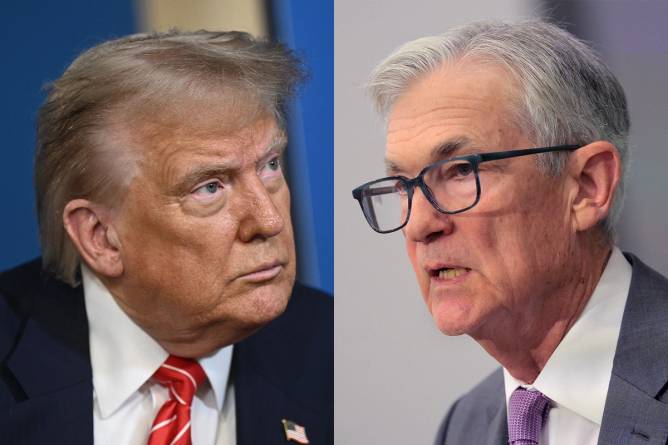
President Donald Trump and Fed Chair Jerome Powell

Brendan Smialowski, Chip Somodevilla/Getty Images

As Jerome Powell was finishing up his summer Capitol Hill tour on Wednesday, The Wall Street Journal reported that President Trump could name a successor to Powell—whose term as Fed chair doesn’t end until May 2026—as early as this summer, potentially anointing a controversial “shadow chair.”

The dollar dropped by over 0.5% yesterday to a three-year low as investors mulled the possible threat to the political independence of the Fed.

The White House said that despite the report, a nomination is not “imminent, although the President has the right to change his mind.” The president, who has threatened to fire Powell for refusing to cut interest rates, said on Wednesday during a press conference that he had “three or four people” in mind for the role.

The speculated shortlist:

  • Former Fed Governor Kevin Warsh interviewed for the job eight years ago alongside Powell, but he has been pretty anti-lowering interest rates lately.
  • National Economic Council Director Kevin Hassett and Treasury Secretary Scott Bessent are considered likely options…but both have said they aren’t interested, according to the Wall Street Journal and DealBook.

Having a Fed Chair on his side might help Trump, but there are 12 voting members of the committee that determines interest rates. Undermining Powell, and by extension the independence of the Fed, with an early nomination could spook other members.—MM

WhatsApp ditches its no-ads policy


WhatsApp advertising update

WhatsApp

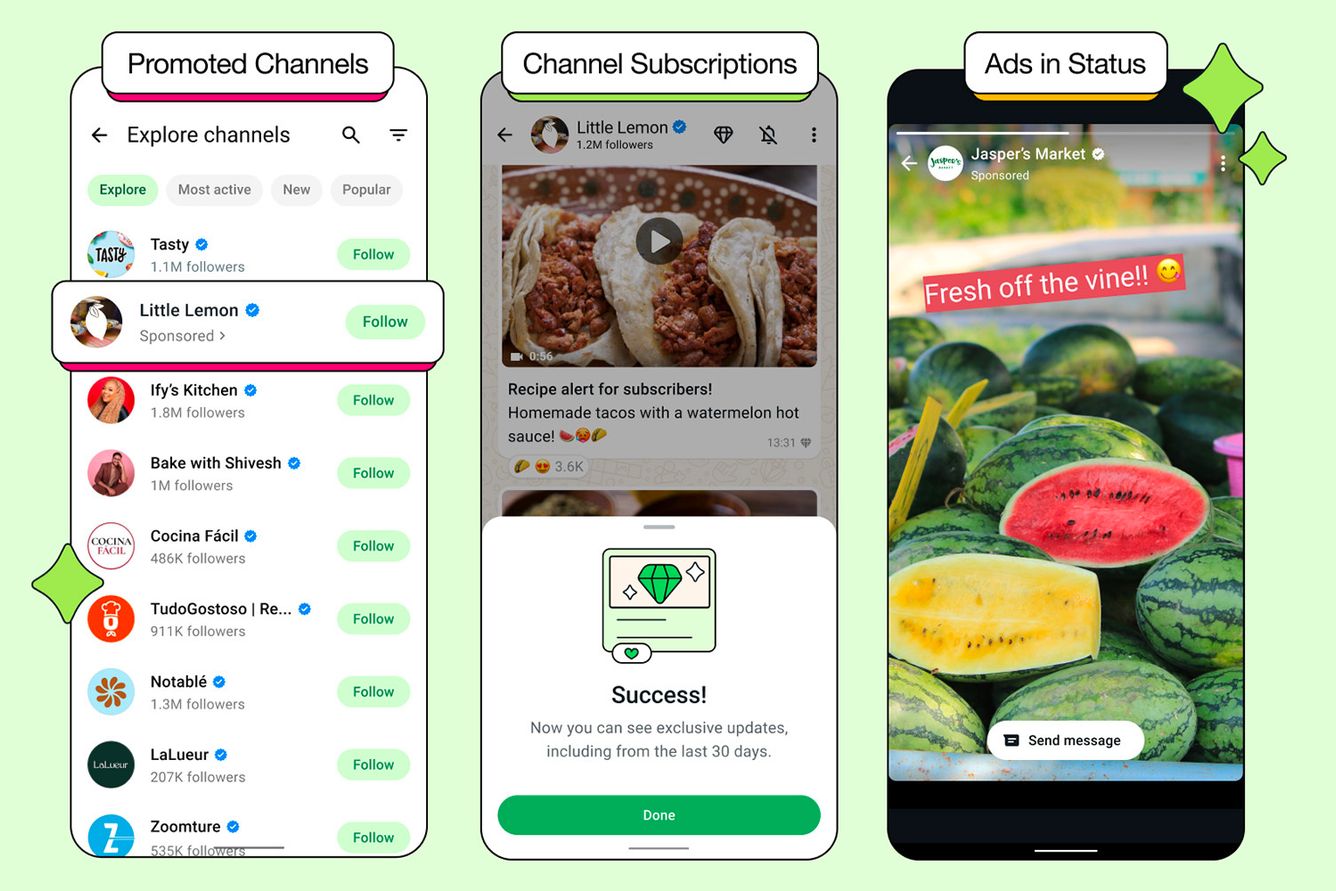
You either die an ad-free hero or live long enough to see yourself become like Instagram: Meta is bringing paid advertising and subscriptions to the world’s most popular messaging platform, the tech giant announced yesterday, reversing WhatsApp’s longtime stance against ads.

You may not notice a difference…if you only use the app to text your international aunts and uncles. Messages will remain ad-free, Meta said. Sponsored content will only appear in Updates, a social tab launched two years ago. Within that section:

  • WhatsApp will start interspersing ads when you’re tapping through Statuses, which is its version of Stories.
  • Creators, brands, and the 200 million businesses using WhatsApp can start monetizing the app’s broadcast channels with subscriptions for their premium content. They’ll also be able to pay WhatsApp to appear higher in the in-app search results.

Users who link their Facebook or Instagram accounts to WhatsApp will get ads that are personalized beyond just their location, language, and channel-following data.

Founder’s remorse? Before Meta (then Facebook) bought WhatsApp for $19 billion in 2014, the platform’s mantra was “No ads! No games! No gimmicks!” Co-founders Brian Acton and Jan Koum reportedly despised digital advertising so much that they both left Meta by 2018—before their stock vested—over the company’s alleged insistence that they bring ads to WhatsApp. Meta’s WhatsApp head denied reports of its ad plans as recently as 2023.

Why monetize WhatsApp now?

Meta has an expensive habit to support: artificial intelligence. Mark Zuckerberg’s company recently invested $14.3 billion in the startup Scale AI, and it’s planning to shell out as much as $50 billion more on AI this year, mostly supported by Meta’s advertising revenue.

WhatsApp is an untapped attention gold mine. WhatsApp has 3 billion global monthly users (only 100 million of whom are in the US), and half of them visit the Updates tab every day, per Meta. On top of an expected influx of ad dollars, Meta also plans to take a 10% cut of WhatsApp channels’ subscription fees.—ML

The Public Lands Grift?


a lightning struck tree

Gary Tognoni/Getty Images

As Senate Republicans take a red pen to the massive tax and spending bill passed by the House last month, some GOP lawmakers are pushing to add a provision that would green-light the potential sale of 2.1 million to 3.2 million acres of public land across 11 Western states.

Land of opportunity: Utah Republican Sen. Mike Lee is leading the charge, saying his sale proposal would only free up a tiny fraction of federal land and that the sales would help drive down housing costs. According to a draft of the provision obtained by Politico’s E&E News, the land will be required to be used for “the development of housing or to address associated infrastructure to support local housing needs.”

Conservationists, hunting groups, and politicians from both sides of the aisle have lined up to oppose the proposal:

  • Several Republican senators oppose the plan, including Tim Sheehy and Steve Daines of Montana, as well as Idaho’s Jim Risch and Mike Crapo.
  • The Senate Energy Committee’s ranking Democrat, Sen. Martin Heinrich, called the proposal a “sledgehammer to our national public lands,” and says it’s unclear whether it would even lead to substantial housing improvements.
  • The Wilderness Society conservation group said in a statement that the sale would be a “betrayal of future generations,” and that it has considerable room to maneuver around some of the housing guarantees, especially in the long term.

Just the Facts on taxes


RG Richardson Economic Interactive Dictionary


RG Richardson Economic Interactive Dictionary. Multi-language Chinese, English and German. With the power of the internet, this guide provides over 9900 links through 8 search engines to definitions, terms, charts, videos and graphs. Never out of date! Increase your financial literacy! Interactive City Guides searching in multiple languages. Job search, interactive notes, dictionaries, shopping and real estate guides. Using the power of the internet this guide is all about 9900 preset searches keeping you up to date about your city. Rolling out in 2022 with 8 search engines and 9900 links using your browser in over 10 different languages; point and click that's it! You can now avoid spelling mistakes and language difficulties making this guide simple enough for everybody to use. Simply click the icon, your search is done, read everything you want to know and it is never out of date. These guides have extensive hotel and restaurant searches; not to mention real estate, shopping, job and employment opportunities available in the guides.

Why Trump’s Attacks On ‘His’ Judges Will Backfire


Why Trump’s Attacks On ‘His’ Judges Will Backfire

The president targets the one conservative institution that can still punch back.

More remarkable developments from Ukraine this morning, which just carried out a third strike on one of Vladimir Putin’s pet projects: the bridge connecting Russia to occupied Crimea. Meanwhile, Russian war bloggers have identified the man they believe to be the mastermind of the drone attacks on military targets across Russia this weekend: former Ukrainian DJ Artem Timofeev. Hey, it’s important for guys to have hobbies. Happy Tuesday.


Leonard Leo, co-chairman of the Federalist Society board of directors, speaks at the Cambridge Union in the U.K. on March 11, 2025. (Photo by Nordin Catic/Getty Images for the Cambridge Union)

Get Away From My Face, You Leopard!

by Andrew Egger

Donald Trump’s breakup with the conservative legal movement was a long time coming. Most presidents would commit unspeakable acts to get the sort of home-field advantage Trump enjoys in the courts—most notably, a 6–3 conservative Supreme Court, a full third of whom he nominated himself. But Trump has long felt this arrangement entitles him to a certain standard of living: a world where he can operate more or less without judicial oversight. When “his” Supreme Court failed to abet his attempt to steal the 2020 election, he raged that they hadn’t had the “courage” to do what was necessary.

Four-plus years later, the pressure is still mounting, and not just at the Supreme Court level. Republican appointees on court after court have enraged the president as they worked to stymie Trump’s lawless actions.

The broader break with judicial conservatism came last week. On the heels of a 3–0 decision at the U.S. Court of International Trade straitjacketing his tariff authority—a decision that starred one of his own judicial nominees—Trump apparently decided he’d had enough. In a baggy, rambling 500-word post to Truth Social¹, he trained his rhetorical fire on judicial conservatism’s ideological home base, the Federalist Society, and its co-founder, former longtime vice president, and current board co-chairman Leonard Leo.

“I was new to Washington, and it was suggested that I use The Federalist Society as a recommending source on Judges,” Trump fumed, calling Leo a “real sleazebag” with “his own separate ambitions.” “I am so disappointed in The Federalist Society because of the bad advice they gave me on numerous Judicial Nominations. This is something that cannot be forgotten!”

I can’t deny there’s a certain “I never thought the leopards would eat my face” schadenfreude to this. Trump’s openly transactional 2016 embrace of the Federalist Society helped soothe the consciences of a lot of skeptical Republicans: How lawless and megalomaniacal could he REALLY be, if he shares our commitment to originalism and judicial restraint? And the Federalist Society types were perfectly content to let Trump slingshot them into the judiciary by the truckload.

Share

But as he now lashes out in pique, Trump stands to hurt himself more than the Federalist Society. As a confederation organized more around a shared judicial approach than personal loyalties, there may be no group in Republican politics less susceptible to simply being bullied into submission. Instead, Federalist Society-sympathetic judges are likely to perceive Trump’s attack for what it really is: a rejection of the notion that even friendly judges should be able to restrain him at all, and a pledge to appoint nothing but unprincipled lickspittles in the future.

As things stand, there is a plethora of ways his attacks could come back to bite the president. They will only accelerate the growing sense among Federalist Society types already wielding significant judicial power that the president’s lawless actions are less an opportunity for testing out novel legal theories than a danger requiring immediate restraint. A Trump who played nice with the conservative legal movement was a Trump who got goodies like a new and expansive SCOTUS-approved definition of “presidential immunity.” Just eleven months after that ruling was handed down, it’s growing harder to imagine the Court deciding that case in the same way today (not that at least two of the justices wouldn’t try to find a way).

Trump also may find that his attempts to more aggressively shape the judiciary according to his whim result in him getting less opportunities to shape it at all. As our friend Gregg Nunziata of the Society for the Rule of Law points out, judges are rational actors who are less likely to retire if they feel they’ll be replaced by a presidential toady.

“Many judges who are eligible to retire or take senior status have been watching to see what they can expect from the White House,” Nunziata told Bloomberg News this week. “These are ominous signs for them.”

Already, we’ve seen other ways in which the legal profession has demonstrated some backbone. Trump’s lawfare campaign against America’s law firms seems to be sputtering out. While the courts have come to the defense of firms that wouldn’t bow to his blackmail, some of the ones that did are paying an unexpected price. The Wall Street Journal reports:

Support for the law firms that didn’t make deals has been growing inside the offices of corporate executives. At least 11 big companies are moving work away from law firms that settled with the administration or are giving—or intend to give—more business to firms that have been targeted but refused to strike deals, according to general counsels at those companies and other people familiar with those decisions.

Yesterday, JVL wrote about what’s becoming a key split screen of Trump 2.0: While official channels start to stiffen their spines against him, he continues to push the envelope anywhere he is permitted to move freely. This is most obvious when it comes to his jubilee of indefensible pardons for allies and his shocking use of federal law enforcement and the military, including the growing deployment of masked plainclothes officers and a purge of top brass thought to be insufficiently “loyal” to Trump himself.

All this is intensely alarming—and if you keep reading below, Bill will alarm you some more. But it would be worse if Trump weren’t finding it tough sledding with civil society and the courts.