Sign up today

Sign up today
Softphone APP for Android &IOS

RG Richardson Communications News

I am a business economist with interests in international trade worldwide through politics, money, banking and VOIP Communications. The author of RG Richardson City Guides has over 300 guides, including restaurants and finance.

Deloitte’s AI use created a blunder Down Under

Deloitte’s AI use created a blunder Down Under

Deloitte’s AI use created a blunder Down Under

The Australian government is getting a refund after a mistake-filled report


Anna Kim
ByDave Lozo
October 6, 2025

• less than 3 min read


You can’t make this up—but perhaps Deloitte’s AI could. The company is giving a partial refund to the Australian government after a $440,000 report was found to contain numerous AI hallucinations, the latest example of how consulting firms are grappling with the new tech.

What went wrong? Australia’s Department of Employment and Workplace Relations asked Deloitte to analyze the efficiency of its welfare system. But academics pointed out mistakes in the firm’s report that included citations to nonexistent studies, AFR reported. Deloitte admitted to using an LLM (Azure OpenAI GPT-4o) and later updated the report, but noted that the updates didn’t change its overall findings or recommendations.
A ‘human intelligence problem’

That’s how Australian Labor Senator Deborah O’Neill described the error. The phrase highlights the issues arising as AI takes over the grunt work formerly done by newbie consultants:The Wall Street Journal spoke to experts who predict consultancies will reap more benefits from AI work in four to five years, when the tech improves. And in May, Anthropic CEO Dario Amodei said that AI could wipe out half of entry-level jobs at white-collar companies within five years.
Harvard Business Review points out that this shift in hiring at professional services firms could leave companies wondering where partners, who do the less routine work now, will come from in the future.

Maybe more AI is the answer: Deloitte announced a massive deal yesterday to provide Anthropic’s Claude to more than 470,000 of its global employees over the next few months.—DL

Children start avoiding information at age seven

Children start avoiding information at age seven
We choose ignorance 
as we age – even when knowledge is more useful
By Bronwyn Thompson
October 05, 2025

Study finds the age at which we decide to turn our brains off more frequentlyDepositphotos
VIEW 1 IMAGES

Whether it's avoiding the news or checking a bank account, adults often deal with uncertainty by switching off and not seeking knowledge – even when that knowledge could be of benefit to us. Now scientists have identified just when in life we start to choose the "ignorance is bliss" path, opting for comfort rather than uncertainty.
University of Chicago researchers have pinpointed the precise age at which we start avoiding information, a behavior known as the Ostrich Effect (even though ostriches don't, in fact, bury their heads in sand) – and it begins a lot earlier in life than you might think. In a series of experiments that looked at information avoidance in 320 American children aged between five and 10 years, they found that younger kids actively sought out knowledge, while by the age of seven individuals became information-avoidant if the answers were potentially going to evoke a negative emotion.
“Why is it that children are these super curious people, but then we somehow end up as these information avoiders as adults?” asked Radhika Santhanagopalan, a post-doctoral researcher from the University of Chicago. “What is this transition?” 
In the first experiment, researchers looked at five potential reasons we might exhibit this "head in the sand" behavior: to avoid negative emotions like anxiety or disappointment; to avoid negative information about our own likability or competence; to avoid challenges to our beliefs; to protect our preferences; and to act in our own self-interest (perhaps while trying to appear not self-interested).
Different scenarios were then constructed to see if avoidant behaviors were elicited and if these reasons were driving them. One test was to have each child think of their favorite and least favorite candy, and then offer the kids the chance to watch a video about why eating each of their choices was bad for their teeth.
“We found that, whereas younger children really wanted to seek information, older children started to exhibit these avoidance tendencies,” said Santhanagopalan. “For example, they didn't want to know why their favorite candy was bad for them, but they were totally fine learning why their least favorite candy is bad for them."
Then there's the curious case of "moral wiggle room" – where individuals will choose to avoid information for self-interest but do so in a way that doesn't seem selfish to others. This was demonstrated with another scenario, in which partnered-up children were presented with two buckets of stickers for themselves and their partner. One bucket offered more stickers, while the other was covered and had an unknown amount of stickers. Before choosing which bucket to claim, participants were asked if they wanted to know how many stickers their partner would get.
“We want to act in our own self-interest, but we also care a lot about appearing fair to other people,” Santhanagopalan said. “Moral wiggle room allows us to achieve both goals.”
While knowing how many their partner might get in the hidden bucket didn't personally affect their own sticker gain, older children increasingly turned down the chance to find out how the other person would benefit. In doing so, it meant there was no guilt that came with choosing the bucket with the unknown amount of stickers for their partner.
“What the moral wiggle room does is allow them to pick the self-interested payoff, while also maintaining the illusion of fairness,” Santhanagopalan said. “That veil of ignorance allows them to act in their own self-interest.”
The findings – that as children got older they increasingly avoided learning information to avoid those negative emotions tied to the knowledge – held true for all but one of the five reasons, and that one was about competence. Kids across the board were not hesitant about finding out if they'd done badly on a test – a situation where the answer could be negative – and the researchers hypothesize that this could be because school fosters growth and positive change, so a bad result is just a minor step on the path to a good outcome.
“It’s possible that because they’re getting all this messaging about how you can change your aptitude if you put in the work,” said Santhanagopalan, “maybe they’re more inclined to seek information because they know they can potentially change the outcome.”
In adulthood, information avoidance is common – it can be overwhelming, threaten long-held beliefs or create fear of uncertainty that is otherwise consciously or unconsciously shut out. The researchers add that this avoidance can have personal and societal consequences, like "deepening political polarization or ideological rigidity."
The team suggests actively questioning why you might be avoiding useful information, where short-term discomfort is prioritized despite the knowledge potentially having long-term benefits. Then trying to reframe the knowledge as ultimately valuable and useful, making you less inclined to actively avoid information.
“Humans have this propensity to want to resolve uncertainty, but when the resolution is threatening, people might flip to avoidance instead," Santhanagopalan said. "I think there's something to be said about being able to tolerate and even embrace some level of uncertainty.
“I think that might help in not falling prey to information avoidance," she added.
The research was published in the journal Psychological Science.
x

Contract-Free and Pay-as-You-Go Hosted Products

Contract-Free and Pay-as-You-Go Hosted Products


phone-numbers

Phone numbers

Purchase local, toll-free, and vanity numbers in over 60 countries or transfer your existing phone numbers seamlessly with our fully self-serve number portability tool. Learn More.
sms_mms

Messaging Suite

Whether you want to send and receive a few messages a day or you want to build an entirely integrated customer experience, we can support you everywhere within U.S. and Canada from your SMS/MMS available number to a wide variety of supporting devices. Learn More.
call_conference

Call Conference

Create your own space and allow several people to be bridged together in the same conversation. Our call conference feature provides the host with a dashboard that allows organizers to monitor and control different aspects of the conference call in real time. You can either host conferences from a local or a toll-free DID. Learn More.
virtual_fax

Virtual Fax

Still leveraging a fax? Time to migrate to a virtual fax in order to send and receive faxes in PDF format on any of your fax available DIDs or have them forwarded to your preferred email address. In the event where you have to keep a physical machine on-site, we can support you too! Learn More.

Trump and Hegseth declare an end to 'politically correct' leadership in the US military

 Trump and Hegseth declare an end to 'politically correct' leadership in the US military


Trump and Hegseth declare an end to 'politically correct' leadership in the US military
Story by Ben Finley, Konstantin Toropin And Evan Vucci
• 17m •
4 min read


President Donald Trump is greeted by Secretary of Defense Pete Hegseth before speaking to a gathering of top U.S. military commanders at Marine Corps Base Quantico, Tuesday, Sept. 30, 2025, in Quantico, Va. (AP Photo/Evan Vucci)© The Associated Press

QUANTICO, Va. (AP) — President Donald Trump and Defense Secretary Pete Hegseth declared an end to “woke” culture in the military and targeted other policies of past administrations Tuesday before hundreds of top U.S. military officials who were abruptly summoned to Virginia from around the world.


Hegseth announced new directives for troops that include “gender-neutral” or “male-level” standards for physical fitness, while Trump bragged about U.S. nuclear capabilities and said the nation's “dangerous cities” should be used as "training grounds for our military.”

Hegseth had called military leaders to convene at the Marine Corps base in Quantico, near Washington, without publicly revealing the reason until this morning. Hegseth’s address largely focused on his own long-used talking points that painted a picture of a military that has been hamstrung by “woke” policies, and he said military leaders should “do the honorable thing and resign” if they don’t like his new approach.


U.S. military senior leadership listen as President Donald Trump speaks at Marine Corps Base Quantico, Tuesday, Sept. 30, 2025 in Quantico, Va. (AP Photo/Evan Vucci)© The Associated Press

Meetings between top military brass and civilian leaders are nothing new, but the gathering had fueled intense speculation about the summit’s purpose given the haste with which it was called and the mystery surrounding it.

Admirals and generals from conflict zones in the Middle East and elsewhere were summoned for a lecture on race and gender in the military, underscoring the extent to which the country’s culture wars have emerged as a front-and-center agenda item for Hegseth’s Pentagon, even at a time of broad national security concerns across the globe.


Secretary of Defense Pete Hegseth speaks to senior military leaders at Marine Corps Base Quantico, Tuesday, Sept. 30, 2025 in Quantico, Va. (Andrew Harnik/Pool via AP)© The Associated Press

The president also warned that “America is under invasion from within.”

“After spending trillions of dollars defending the borders of foreign countries, with your help we’re defending the borders of our country,” Trump said.

Trump is used to boisterous crowds of supporters who laugh at his jokes and applaud his boasts during his speeches. But he wasn't getting that kind of soundtrack from the generals and admirals in attendance.

In keeping with the nonpartisan tradition of the armed services, the military leaders sat mostly stone-faced through Trump’s politicized remarks, a contrast from when rank-and-file soldiers cheered during Trump’s speech at Fort Bragg this summer.


U.S. military senior leadership are seen before President Donald Trump arrives to speaks at Marine Corps Base Quantico, Tuesday, Sept. 30, 2025 in Quantico, Va. (AP Photo/Evan Vucci)© The Associated Press

During his nearly hour-long speech, Hegseth said the U.S. military has promoted too many leaders for the wrong reasons based on race, gender quotas and “historic firsts.”

“The era of politically correct, overly sensitive don’t-hurt-anyone’s-feelings leadership ends right now at every level,” Hegseth said.


That was echoed by Trump, who said “the purposes of America military is not to protect anyone’s feelings. It’s to protect our republic.″

″We will not be politically correct when it comes to defending American freedom,” Trump said. “And we will be a fighting and winning machine.”

Hegseth said he is loosening disciplinary rules and weakening hazing protections, putting a heavy focus on removing many of the guardrails the military had put in place after numerous scandals and investigations

Hegseth said he was ordering a review of “the department’s definitions of so-called toxic leadership, bullying and hazing to empower leaders to enforce standards without fear of retribution or second guessing.”

He called for “changes to the retention of adverse information on personnel records that will allow leaders with forgivable, earnest, or minor infractions to not be encumbered by those infractions in perpetuity.”


“People make honest mistakes, and our mistakes should not define an entire career,” Hegseth said. “Otherwise, we only try not to make mistakes.”

Bullying and toxic leadership has been the suspected and confirmed cause behind numerous military suicides over the past several years, including the very dramatic suicide of Brandon Caserta, a young sailor who was bullied into killing himself in 2018.

A Navy investigation found that Caserta’s supervisor’s “noted belligerence, vulgarity and brash leadership was likely a significant contributing factor in (the sailor)’s decision to end his own life.”

Hegseth used the platform to slam physical fitness and grooming standards, environmental policies and transgender troops while talking up his and Trump's focus on “the warrior ethos” and “peace through strength.”

Hegseth said the department has been told from previous administrations that “our diversity is our strength,” which he called an “insane fallacy.”


“They had to put out dizzying DEI and LGBTQE+ statements. They were told females and males are the same thing, or that males who think they’re females is totally normal,” he said, adding the use of electric tanks and the COVID vaccine requirements to the list as mistaken policies.

Hegseth said this is is not about preventing women from serving.

“But when it comes to any job that requires physical power to perform in combat, those physical standards must be high and gender neutral,” he said. “If women can make it excellent, if not, it is what it is. If that means no women qualify for some combat jobs, so be it. That is not the intent, but it could be the result.”

Hegseth's speech came as the country faces a potential government shutdown this week and as Hegseth, who has hammered home a focus on lethality, has taken several unusual and unexplained actions, including ordering cuts to the number of general officers and firings of other top military leaders.

___

Finley and Toropin reported from Washington. Associated Press writer Sylvie Corbet in Paris contributed to this report.

Ben Finley, Konstantin Toropin And Evan Vucci, The Associated Press


Bill Gates pledges $1b for global disease fight, urges governments to step up | The Straits Times

Bill Gates pledges $1b for global disease fight, urges governments to step up | The Straits Times

Bill Gates pledges $1b for global disease fight, urges governments to step up


Get ST's newsletters delivered to your inbox


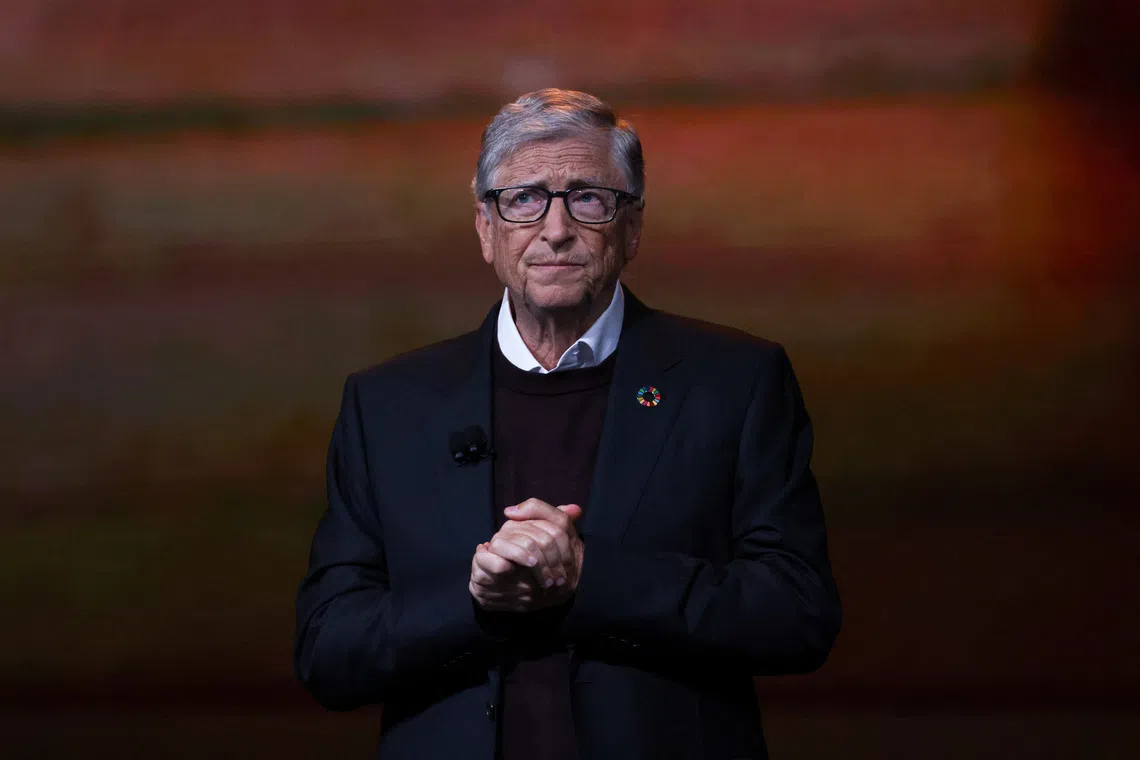
Philantropist Bill Gates making his opening remarks during the annual Gates Foundation's Goalkeepers Summit in Manhattan, New York, on Sept 22.

PHOTO: REUTERS

Follow topic:Bill Gates


Published Sep 23, 2025, 07:36 AM


Updated Sep 23, 2025, 07:06 PM


NEW YORK - The Gates Foundation will give US$912 million (S$1 billion) to the Global Fund to Fight Aids, Tuberculosis and Malaria, philanthropist Bill Gates announced on Sept 22 as he urged governments to reverse global health funding cuts.

Speaking at a Reuters Newsmaker event in New York, Mr Gates said the world was at a crossroads, with millions of children at risk of dying if funding drops too steeply.

The Gates Foundation’s pledge matches its donation in 2022. That was the last time the Global Fund, a Geneva-based independent non-profit, raised money on its three-year budget cycle.


The announcement follows deep aid cuts from governments around the world, led by the United States.

“A kid born in northern Nigeria has a 15 per cent chance of dying before the age of five. You can either be part of improving that or act like that doesn’t matter,” Mr Gates said in an interview before the foundation’s annual Goalkeepers event in New York on Sept 22. The event celebrates and seeks to accelerate progress on United Nations global development goals set for 2030, including improving health and ending poverty.

“I am not capable of making up what the government cuts, and I don’t want to create an illusion of that,” he said about his pledge.


The Gates Foundation, the philanthropy started by the Microsoft co-founder and his then wife in 2000, is one of the world’s biggest funders of global health initiatives, with a particular focus on ending preventable deaths of mothers and babies, tackling infectious diseases and lifting millions out of poverty.

FICO just upended the credit score market


Credit bureaus getting bypassed by FICO

Francis Scialabba

A magic number that can determine whether you’ll be a homeowner will be sent to mortgage companies without intermediaries.

Fair Isaac, the company that creates FICO credit scores, announced yesterday that it’ll offer them directly to the lending industry, eliminating the need for credit reporting agencies Experian, Equifax, and TransUnion in the transactions. The trio’s stocks were down 4.3%, 8%, and 11% at market close, respectively.

Sidelined

Fair Isaac’s shares rallied over 18% as it moved to loosen the credit bureaus’ grip on the mortgage process:

  • The three companies specializing in detailed credit reports currently resell FICO scores with a markup to firms supplying compiled credit reports to lenders. The change could diminish their profit by as much as 15%, according to Jeffries.
  • But starting now, Fair Isaac will license FICO scores directly for a flat $10 fee whether or not a loan is closed, or a $4.95 fee plus a $33 fee if a loan is inked, which it says will make an average score pull 50% cheaper for industry players—savings that could be passed on to homebuyers.

It’s a bone for regulators…that comes after Federal Housing Finance Agency Director Bill Pulte accused Fair Isaac of monopolizing the credit score industry. Earlier this year, the agency let government-backed lenders use credit scores from FICO’s rival, VantageScore—which was created by the three credit bureaus.—SK

The new Hitler Youth - history repeats once again


Private Jet-Flying, Charlie Kirk-Wannabe Teen Sets Off MAGA Firestorm

The fight over Brilyn Hollyhand symbolizes a bigger problem for MAGA.

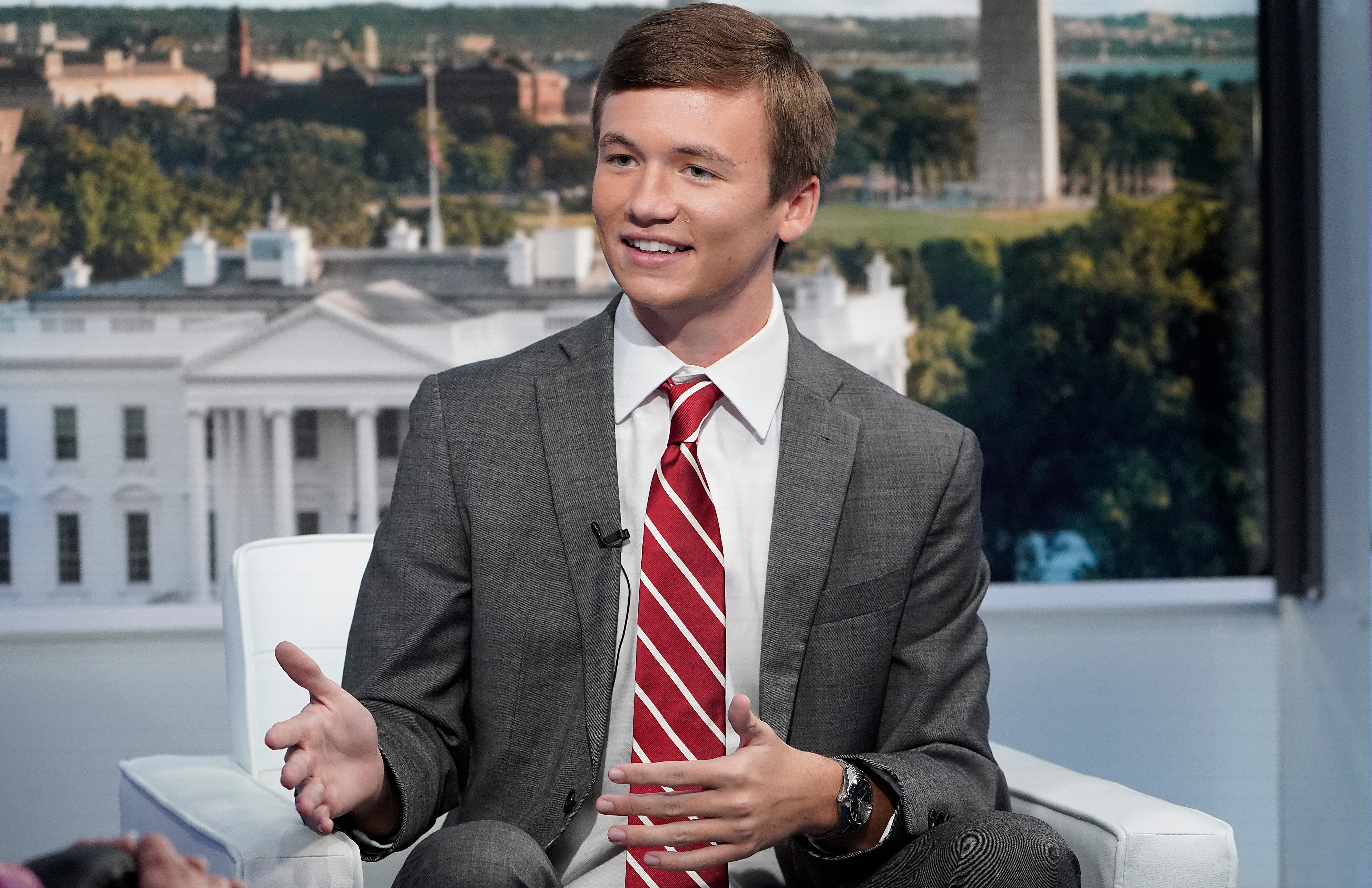
Brilyn Hollyhand during an appearance on Here’s the Deal With Kellyanne at the studios of the Fox News Channel on September 11, 2024 in New York City. (Photo by John Lamparski/Getty Images)


ASPIRING CONSERVATIVE PUNDIT Brilyn Hollyhand had a good thing going. Charlie Kirk’s assassination had put new energy into the pro-Trump speaking circuit on college campuses, giving Hollyhand—a 19-year-old with an encyclopedic grasp of Republican talking points—an opportunity to rack up national media hits discussing Kirk’s legacy and bringing fresh attention to his own Kirk-like campus events.

And, for a little while, Hollyhand was handily meeting the moment. He went on a number of TV networks and podcasts to memorialize his “mentor” Kirk, and he also launched a ten-stop “One Conversation at a Time” speaking series that he said was being done in partnership with Kirk’s Turning Point USA outfit.

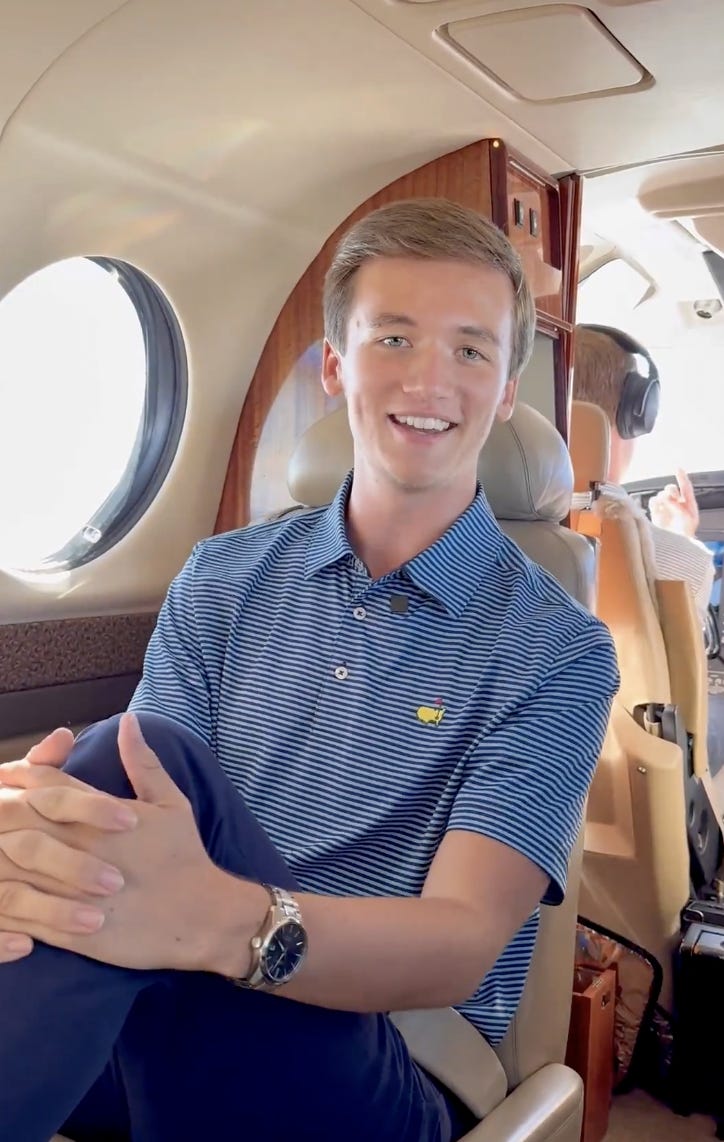
But the teenager made a tactical error on Thursday when he posted a video of himself flying on a private jet to his next speaking stop, a luxury watch apparently on his wrist. Paired with a recent New York Post profile anointing him as Kirk’s “protege,” this was all a bit much for many conservatives.

(Screenshot via @BrilynHollyhand on X)

And it prompted some of them to ask: Wait, how did this improbably named guy come to claim Kirk’s mantle?

Nick Sortor, a Republican influencer who cohosted an episode of Kirk’s show after his assassination, called Hollyhand a “grifter” and said his campus tour was a “distraction” from TPUSA’s actual college campus work.

Hollyhand has tried to tamp down the private-jet backlash by claiming a “hometown friend” lent him the jet for the first leg of his tour. This seems reasonable: Who doesn’t have a friend willing to lend out their private jet at a moment’s notice?

Yet the anger at Hollyhand continued through the weekend. And it points to a bigger issue that is roiling the Trump coalition in the wake of Kirk’s death.

The emerging divide isn’t just over who, specifically, is going to be the main figure helping to further Kirk’s mission of organizing young conservatives. It’s also about what it actually means to be a young conservative in the age of Trump.

Share

Despite not yet having hit the legal drinking age, Hollyhand actually has been in Republican political circles for some time now. He has been involved in the conservative YouTube and podcasting circuit for years, delivering campus speeches and appearing at confabs. He started the “Truth Gazette” email newsletter at the tender age of 11 (we respect the hustle). Last year, he was involved in a “Get Off the Sidelines Tour” with TPUSA, released a book with one of the major conservative publishing houses, and was a member of the Republican National Committee’s youth council.

His vibe is very “country club”—and we mean that quite literally: In the now-infamous private jet video, he is sporting a striped polo shirt with the Master’s logo on it. In his speeches, he comes off like a throwback to a pre-Trump Republican party, delivering bland talking points about American opportunity and capitalism. The private jet cemented the idea that he is being foisted onto young conservatives by wealthy donors who want to steer the Gen-Z right in the direction of more traditional, buttoned-up Republican beliefs. Perhaps worst of all, conservatives fear Hollyhand just doesn’t have the juice to win more young people to the Republican party.

“We CANNOT let the GOP fall back into this garbage,” moaned popular far-right X account and antisemite “Captive Dreamer” in response to a Hollyhand clip about left-wing anti-Israel protests.

Hollyhand is distinctly swagless. That 2024 book on conservative youth, One Generation Away, reads like a greatest-hits collection from CPAC 2004; it goes heavy on Ronald Reagan. And while Hollyhand insists he wrote the book himself (in secret, while in high school), in his acknowledgments, Hollyhand also thanks a long list of supporters involved in its creation—including Sen. Katie Britt (R-Ala.) and her husband, with whom Hollyhand claims to be friends.


Pick and choose which Bulwark newsletters and podcasts arrive in your inbox:


In an era when young Republicans are more likely to find inspiration in obese toad memes and beef-tallow recipes, the earnest Hollyhand gives off the vibe of a Latter-day Saints missionary venturing into the depths of the Amazon. Mike Adams, a nutrition-supplement pusher and conspiracy theorist associated with Alex Jones, inadvertently summarized his camp’s complaint when he called Hollyhand a “goober.”

“This kid never earned anything that would justify the publicity that’s being bought and placed upon him,” Adams tweeted.

Of course, Kirk himself was ridiculed for years—on the right and far beyond—for embodying what a rich Republican would imagine a young Republican to be. And, like Hollyhand, he relied on the largesse of wealthy benefactors. If Hollyhand has learned anything from Kirk, it should be that the memes about his fancy trappings and rich backers can actually help him achieve the crossover social-media ubiquity that Kirk enjoyed.

But Hollyhand’s personal affluence poses additional problems. His family has grown wealthy from building affordable housing—a cardinal sin on the segregationist right. To them, the Hollyhands benefited from bringing poor, mostly minority families on Section 8 vouchers into white neighborhoods, meaning they’re exactly the kind of race-blind conservatives people like Captive Dreamer think the Republican party should leave behind.


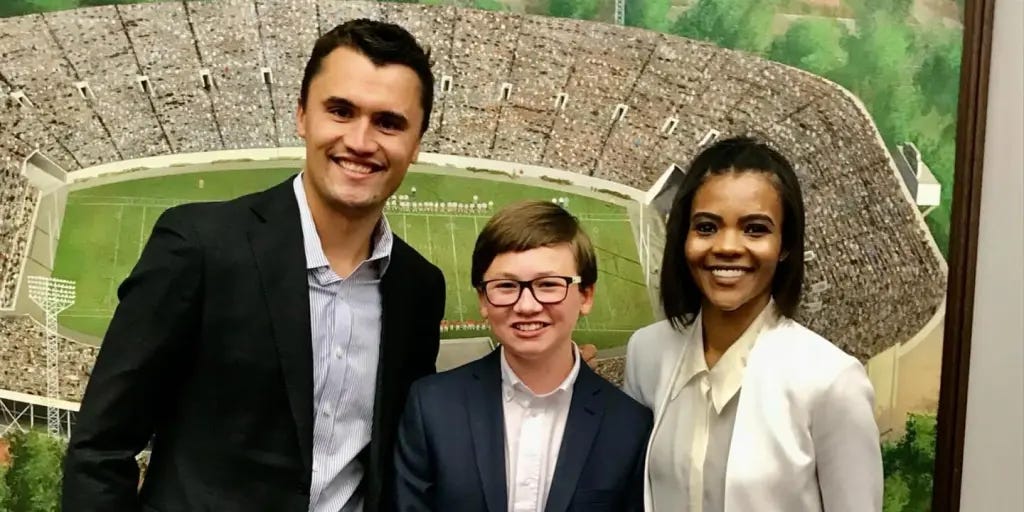
To defend his claim to even a tiny slice of Kirk’s legacy, Hollyhand has turned to an increasingly popular tactic in the aftermath of Kirk’s assassination: posting a handful of text messages from the slain activist that suggest, at best, that they had a friendly acquaintance. Hollyhand also noted that he interviewed Kirk and then-TPUSA associate Candace Owens when he was still in middle school.

(Screenshot via @brilynhollyhand on Instagram.)

Top Turning Point USA brass haven’t been impressed. And some aren’t sitting back while letting Hollyhand become the face of Gen-Z conservatism.

TPUSA chief operating officer Tyler Bowyer, in particular, has been on a tear against Hollyhand on X, claiming that Hollyhand “let us all down” by supporting then-RNC chief Ronna McDaniel when he was on the RNC’s youth team.

Hollyhand has claimed his current campus tour is “sponsored” by TPUSA, which would seem to lend him a sort of Charlie Kirk 2.0 imprimatur from the organization. But Bowyer counters that Hollyhand separately organized visits to just a few TPUSA chapters, and is now using that fact to falsely claim an association with the organization.

“Although it has come off as distasteful, usually these things work themselves out,” Bowyer tweeted.

Hollyhand’s advocates have offered a relatively light defense of the young man’s aspirations, but their main point is quite reasonable. It is essentially that Hollyhand isn’t really doing anything other influencers on the right aren’t also doing. Right-wing activist Laura Loomer said Hollyhand’s critics on the right were being unfair to a guy who is simply trying to honor Kirk in his own way. As for why he was engendering such hate, Loomer suggested it was driven by envy.

“Don’t be so jealous of him because he comes from money and you don’t,” tweeted.

The End of the American Experiment. 1776 to 2025. - YouTube

The End of the American Experiment. 1776 to 2025. - YouTube

Whoa, well done! A must see and to the end. So stand up and take one in the Family Jewels and get going on the resistance to the Regime. It would take divine intervention for the Democrats to win an election.

Milei’s Argentina needs a financial lifeline


Argentinian President Javier Milei is tight on cash, and everyone is mad at him. In an effort to stave off economic collapse, keep the bill collectors at bay, divert attention from a bribery scandal, and calm growing political tension before his country’s midterm elections next month, Milei asked a friend for help.

President Trump met with the chainsaw-wielding leader yesterday (he left the chainsaw at home) at the United Nations General Assembly in New York, where he pledged his full support to the country—but said they don’t need a bailout:

  • Milei’s allyship with the US is working in his favor: Treasury Secretary Scott Bessent promised to offer “all options for stabilization,” including a direct loan.
  • The World Bank said it would speed up sending $4 billion to the country as part of a larger $12 billion package it announced in April.

A drop in the bucket

The continued allyship from Trump and his administration might buy Milei and his ultra-libertarian, free-market plan a little more time, but…it’s not looking good. When Milei was elected in 2023, he promised to bring down inflation from nearly 26% in 2023, which he did. It was 1.9% last month.

But economists say Milei’s strategy—to overvalue the peso against the US dollar—was shortsighted and ultimately devastated Argentina’s economy in other ways.

While Milei anticipated a V-shaped recovery, unemployment has jumped from 5.7% to 7.6% since he took office. Inflating the peso has also tanked economic growth and made it impossible for Argentina’s central bank to replenish its dwindling reserves:

  • Last week, the central bank spent $1.1 billion of the reserve’s $20 billion in just three days to keep the peso’s value up.
  • And next year, the country needs to pay roughly $9.5 billion in debt payments.

The timing couldn’t be worse for Milei: As businesses in the country close and unemployment rises, his approval rating is plummeting ahead of the country’s October midterms, jeopardizing his support in Congress.—MM


Why is Sam Altman losing sleep? OpenAI CEO addresses controversies in interview

Why is Sam Altman losing sleep? OpenAI CEO addresses controversies in interview

Why is Sam Altman losing sleep? OpenAI CEO addresses controversies in sweeping interview
Published Mon, Sep 15 20255:03 AM EDTUpdated 4 Hours Ago

Dylan Butts@in/dylan-b-7a451a107
ShareShare Article via FacebookShare Article via TwitterShare Article via LinkedInShare Article via Email
Key Points
In a sweeping interview last week, OpenAI CEO Sam Altman admitted that he hasn’t had “a good night of sleep” since ChatGPT launched in 2022.
The influential CEO addressed a number of dire concerns including how to address suicide, chatbot morality, privacy and other ethical questions.


Sam Altman, CEO of OpenAI, and Lisa Su, CEO of Advanced Micro Devices, testify during the Senate Commerce, Science and Transportation Committee hearing titled “Winning the AI Race: Strengthening U.S. Capabilities in Computing and Innovation,” in Hart building on Thursday, May 8, 2025.
Tom Williams | CQ-Roll Call, Inc. | Getty Images


In a sweeping interview last week, OpenAI CEO Sam Altman addressed a plethora of moral and ethical questions regarding his company and the popular ChatGPT AI model.

“Look, I don’t sleep that well at night. There’s a lot of stuff that I feel a lot of weight on, but probably nothing more than the fact that every day, hundreds of millions of people talk to our model,” Altman told former Fox News host Tucker Carlson in a nearly hour-long interview.


“I don’t actually worry about us getting the big moral decisions wrong,” Altman said, though he admitted “maybe we will get those wrong too.”

Rather, he said he loses the most sleep over the “very small decisions” on model behavior, which can ultimately have big repercussions.

These decisions tend to center around the ethics that inform ChatGPT, and what questions the chatbot does and doesn’t answer. Here’s an outline of some of those moral and ethical dilemmas that appear to be keeping Altman awake at night.
How does ChatGPT address suicide?


According to Altman, the most difficult issue the company is grappling with recently is how ChatGPT approaches suicide, in light of a lawsuit from a family who blamed the chatbot for their teenage son’s suicide.

The CEO said that out of the thousands of people who commit suicide each week, many of them could possibly have been talking to ChatGPT in the lead-up.


“They probably talked about [suicide], and we probably didn’t save their lives,” Altman said candidly. “Maybe we could have said something better. Maybe we could have been more proactive. Maybe we could have provided a little bit better advice about, hey, you need to get this help.”

watch now
VIDEO12:19
Jay Edelson on OpenAI wrongful death lawsuit: We’re putting OpenAI & Sam Altman on trial, not AI


Last month, the parents of Adam Raine filed a product liability and wrongful death suit against OpenAI after their son died by suicide at age 16. In the lawsuit, the family said that “ChatGPT actively helped Adam explore suicide methods.”

Soon after, in a blog post titled “Helping people when they need it most,” OpenAI detailed plans to address ChatGPT’s shortcomings when handling “sensitive situations,” and said it would keep improving its technology to protect people who are at their most vulnerable.
How are ChatGPT’s ethics determined?


Another large topic broached in the sit-down interview was the ethics and morals that inform ChatGPT and its stewards.

While Altman described the base model of ChatGPT as trained on the collective experience, knowledge and learnings of humanity, he said that OpenAI must then align certain behaviors of the chatbot and decide what questions it won’t answer.

“This is a really hard problem. We have a lot of users now, and they come from very different life perspectives... But on the whole, I have been pleasantly surprised with the model’s ability to learn and apply a moral framework.”

When pressed on how certain model specifications are decided, Altman said the company had consulted “hundreds of moral philosophers and people who thought about ethics of technology and systems.”

An example he gave of a model specification made was that ChatGPT will avoid answering questions on how to make biological weapons if prompted by users.

“There are clear examples of where society has an interest that is in significant tension with user freedom,” Altman said, though he added the company “won’t get everything right, and also needs the input of the world” to help make these decisions.
How private is ChatGPT?


Another big discussion topic was the concept of user privacy regarding chatbots, with Carlson arguing that generative AI could be used for “totalitarian control.”

In response, Altman said one piece of policy he has been pushing for in Washington is “AI privilege,” which refers to the idea that anything a user says to a chatbot should be completely confidential.

“When you talk to a doctor about your health or a lawyer about your legal problems, the government cannot get that information, right?... I think we should have the same concept for AI.”

watch now
VIDEO02:35
OpenAI CEO Sam Altman on path to profitability: Willing to run at a loss to focus on growth


According to Altman, that would allow users to consult AI chatbots about their medical history and legal problems, among other things. Currently, U.S. officials can subpoena the company for user data, he added.

“I think I feel optimistic that we can get the government to understand the importance of this,” he said.
Will ChatGPT be used in military operations?


Asked by Carlson if ChatGPT would be used by the military to harm humans, Altman didn’t provide a direct answer.

“I don’t know the way that people in the military use ChatGPT today... but I suspect there’s a lot of people in the military talking to ChatGPT for advice.”

Later, he added that he wasn’t sure “exactly how to feel about that.”

OpenAI was one of the AI companies that received a $200 million contract from the U.S. Department of Defense to put generative AI to work for the U.S. military. The firm said in a blog post that it would provide the U.S. government access to custom AI models for national security, support and product roadmap information.
Just how powerful is OpenAI?


Carlson, in his interview, predicted that on its current trajectory, generative AI and by extension, Sam Altman, could amass more power than any other person, going so far as to call ChatGPT a “religion.”

In response, Altman said he used to worry a lot about the concentration of power that could result from generative AI, but he now believes that AI will result in “a huge up leveling” of all people.