Sign up today

Sign up today
Softphone APP for Android &IOS

RG Richardson Communications News

I am a business economist with interests in international trade worldwide through politics, money, banking and VOIP Communications. The author of RG Richardson City Guides has over 300 guides, including restaurants and finance.

Gemini - Introducing temporary chats and new data controls

Save money by buying a private jet - for the wealthy


White private jet on a runway during the day

Markus Mainka/Adobe Stock

Don’t cry because you’re not going to Aspen this year, smile because a ski family might avoid paying some taxes by flying there privately. Bloomberg reported yesterday that ultra-wealthy Americans are taking full advantage of a new rule in the One Big Beautiful Bill Act that allows them to completely write off certain high-value assets.

ICYMI: President Trump’s landmark legislation expanded a tax break known as bonus depreciation, which now lets business owners deduct 100% of certain purchases from their taxable income. Eligible splurges include yachts, cars, racehorses, and private jets—as long as they’re used for business more than half of the time. Demand is climbing:

  • Sales of private jets are up by 11% from this time last year, according to data from the jet broker Global Charter.
  • Horse sales at the world’s largest thoroughbred auction in Kentucky grew by 24% last month compared to 2024.

Gas stations and car washes also qualify. Sales of these establishments spiked after Trump temporarily expanded bonus depreciation in 2017. One entrepreneur told Bloomberg that he avoided millions of dollars in taxes by buying several car washes, which offset income from the sale of his family business.

Looking ahead…this rule will cost the IRS $363 billion in lost revenue over the next decade, according to estimates by Congress’s Joint Committee on Taxation.—ML

Canada PM Carney says world can move on without US, stresses new ties | The Straits Times

Canada PM Carney says world can move on without US, stresses new ties | The Straits Times

Canada PM Carney says world can move on without US, stresses new ties


Get ST's newsletters delivered to your inbox


Canadian Prime Minister Mark Carney has focused on reducing the Canadian economy’s reliance on the US.

PHOTO: REUTERS

Follow topic:Canada


Published Nov 23, 2025, 10:12 PM


Updated Nov 23, 2025, 11:40 PM


JOHANNESBURG – Canadian Prime Minister Mark Carney said the world can make progress on a range of issues without the US, and that consensus reached at a Group of 20 (G-20) leaders’ meeting in Johannesburg this weekend carries weight despite a boycott by US President Donald Trump’s administration.

South Africa, the G-20 host for 2025, defied the US by releasing a declaration from the meeting.

Mr Trump ordered the stayaway after repeating a debunked claim that White Afrikaner farmers in South Africa are

being subjected to a genocide, and Washington said only a chairman’s summary could be released from the gathering in the absence of the US.


The summit “brought together nations representing three-quarters of the world’s population, two-thirds of global gross domestic product and three-quarters of the world’s trade, and that’s without the United States formally attending”, Mr Carney told a press conference in Johannesburg on Nov 23.

“It’s a reminder that the centre of gravity in the global economy is shifting.”

Mr Carney took office earlier in 2025 after running a campaign that pushed back against Mr Trump’s imposition of tariffs on its northern neighbour and suggestions

it could become part of US territory.


Mr Carney has focused on reducing the Canadian economy’s reliance on the US.


Top stories

Swipe. Select. Stay informed.


Singapore
Civil servants to receive 1.3 months’ year-end bonus


Singapore
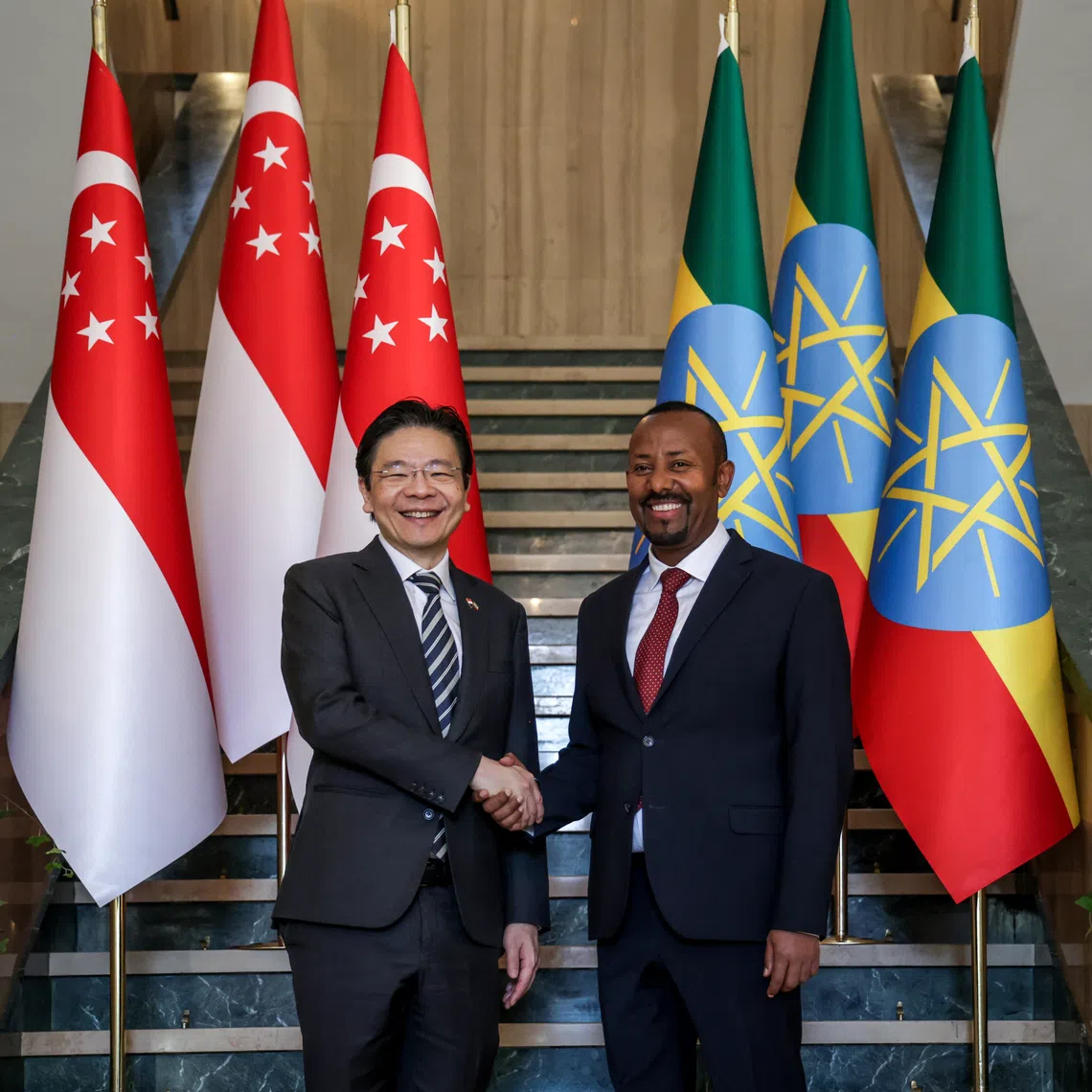
Singapore to open embassy in Addis Ababa as ties with Ethiopia grow


Singapore
Project Wolbachia to be expanded to four new locations from Dec 16


Singapore
Jail, caning for man who raped woman after stalking her and offering her a lift home


Asia
100kg iron rod detaches from truck in Johor, pierces car and kills passenger


Singapore
Eight-storey fish farm, sea-based cages left vacant by exiting farms to be taken over by new owners


Singapore
Singaporean Amos Yee in ICE detention facility barely a week after being released on parole in US


Singapore
Insufficient evidence to show driver caused road accident that killed delivery rider: Coroner report


At the press conference, he detailed his attempts to strengthen ties with nations ranging from South Africa to India and China.

After a Nov 20 meeting in Abu Dhabi with the United Arab Emirates President Sheikh Mohamed bin Zayed, the Gulf country committed to investing C$70 billion (S$64.9 billion) in Canada, Mr Carney said, without providing specific details.


That is the biggest investment pledge Canada has ever received.

“We’re signing new deals and finding new investors to fuel our plans for Canada’s economic ambition,” he said. “We’ll expand trade and catalyse investment in increased partnerships across a range of areas from artificial intelligence to energy in the Indo-Pacific and Europe.”

Mr Carney met South African President Cyril Ramaphosa on Nov 22, congratulated him on holding a successful G-20 summit, reiterated Canada’s support for his presidency of the bloc and pledged to build closer economic ties, according to a statement.

The Canadian leader said he was due to meet Mr Narendra Modi, India’s leader, in Johannesburg on Nov 23 and they are working on improving strained relations.

In 2023, Canada said Indian agents may have been involved in

assassinating a Canadian citizen of Indian origin on its soil – an allegation New Delhi rejected.


Mr Carney emphasised that he will not have his agenda dictated by Mr Trump.

“I’ll speak to him again when it matters,” he said. “I don’t have a burning issue to speak with the President about right now. When America wants to come back and have the discussions on the trade side, we will have those discussions.” BLOOMBERG

Weapons startup Anduril worth $14b after latest funding round

Weapons startup Anduril worth $14b after latest funding round


Weapons startup Anduril worth $14b after latest funding round
Anduril won a contract this year with the US Air Force to create uncrewed fighter jet prototypes.

Anduril
ByMatty Merritt
August 8, 2024

• less than 3 min read


It’s like no one even bothered to watch the latest Mission: Impossible movie. The AI weapons startup Anduril Industries, named after the sword used by The Lord of the Rings character Aragorn, is now worth $14 billion after a new funding round.

Founded by Palmer Luckey, the guy who also started the company that lets you virtually powerwash a digital driveway, Anduril’s goal is to disrupt defense giants with new technologies. The startup plans to use the $1.5 billion it raised in the latest funding round to build a manufacturing platform called Arsenal-1 that can churn out autonomous weapons systems much faster than is currently possible.Anduril won a contract this year with the US Air Force to create uncrewed fighter jet prototypes, beating out Lockheed Martin, Boeing, and Northrop Grumman.
The startup is justifying its “hyper-scale” plans with its prediction that the US would run out of munitions in about eight days if it were to enter a global war, specifically against China. Some experts warn that the claim only serves to fan the flame of conflict.

What else can we do with artificial int—oh, more weapons. Microsoft and Palantir—another startup named after an object from LOTR—announced yesterday they are partnering to provide AI services to US defense and intelligence agencies.

How to Stop Spam Calls with VoIP.ms: Smart Call Blocking Tips - VoIP.ms Blog

How to Stop Spam Calls with VoIP.ms: Smart Call Blocking Tips - VoIP.ms Blog

Sales Support Log in

Products

How to Stop Spam Calls with VoIP.ms: Smart Call Blocking Tips24 June 2025Tags: Features, Use Case

You’re at home relaxing or busy at work when the phone rings from an unknown number. You answer, thinking it might be important, but surprise: it’s a spam call.

These unwanted, often automated calls are usually designed to trick you into giving away personal information, sending money, or buying something.

They may come as robocalls, with pre-recorded messages, or spoofed calls, where the caller disguises their number to appear more trustworthy.

Spam calls have become so widespread that countries like Canada have launched campaigns to help people avoid them.

The Canadian Radio-television and Telecommunications Commission, for instance, advises users to register their residential, wireless, fax, or VoIP number on the National Do Not Call List (DNCL).

Fortunately, VoIP technology offers effective tools to block spam calls. Features like Interactive Voice Response (IVR) can act as a smart robocall filter, helping you stop spam before it reaches you.

Demolition President


The facade of the East Wing of the White House is demolished by work crews on October 20, 2025 in Washington, DC. The demolition is part of U.S. President Donald Trump’s plan to build a ballroom reportedly costing $250 million on the eastern side of the White House. (Photo by Kevin Dietsch / Getty Images.)

Demolition President

by William Kristol

In October 1943, the British Parliament debated the rebuilding of the House of Commons, which had been destroyed a couple of years before in the Blitz. Against others who favored using a more modern, semicircular design—more like that of many other parliaments—Prime Minister Winston Churchill made the case for preserving the original shape of the Commons.

Part of Churchill’s argument was simply the case for honoring tradition. But Churchill also argued that the original, rectangular layout of the House, with benches facing each other in close proximity, encouraged vigorous and direct debate between the parties. And he claimed that the small size of the House, with not enough seats for every member, created a sense of intimacy and urgency for the discussion, especially during important moments.

How much did all this matter? Well, as Churchill said: “We shape our buildings; thereafter they shape us.”

Eighty-two years later, the president of the United States is reshaping the White House. In July, Donald Trump announced he wanted to add a 90,000-square-foot ballroom to the existing building. The ballroom would dwarf the 55,000 square feet footprint of the main part of the White House. Still, Trump assured one and all, “It won’t interfere with the current building. It’ll be near it but not touching it—and pays total respect to the existing building.”

It turns out Trump was lying. Shocking, I know. Yesterday, construction workers began the demolition of part of the East Wing in order to build a new, Mar-a-Lago-like ballroom.

Trump hasn’t gotten approval for this project from the National Capital Planning Commission, which regulates the construction of federal buildings. The Trump-appointed head of the commission, Will Scharf—who, conveniently, is also the White House staff secretary—said during the only public meeting about the matter that the board has no jurisdiction over demolition or site preparation.

While Trump is proud of his new ballroom, others in the administration seem touchy. The Wall Street Journal reported last night that the Treasury Department instructed employees not to share images of the demolition, after photos of construction equipment dismantling the front of the building made their way online.

It’s unclear what legal authority the Treasury Office of Public Affairs has to tell employees what photos they can take during their lunch break. But why would that matter to the Trump administration?

In any case, Trump—aided and abetted by all the corporations and wealthy donors who have contributed money to his project—will presumably be able to do as he pleases. And perhaps it’s foolish to object. If we’re going to transition under Trump’s rule from a (mostly) dignified democratic republic to an ostentatious oligarchic autocracy, our buildings should reflect and reinforce that progress. After all, we shape our buildings; thereafter they shape us.

Canada weighs F-35 and Gripen fleet - Gripen seems obvious

Canada weighs F-35 and Gripen fleet, seeks industrial return

Canada delays F-35 decision as Ottawa weighs Gripen option and industrial return
ByClement Charpentreau
October 19, 2025, 14:44 (UTC +3)
24 commentsDefenseSoos Jozsef / Shutterstock.com


Canada’s long-delayed F-35A fighter jet program is facing renewed uncertainty as Prime Minister Mark Carney’s government weighs whether to proceed with its planned fleet of 88 aircraft from Lockheed Martin or diversify toward a mixed fleet that could include Saab’s Gripen E.

The Liberal government first announced in March 2025 that it would “review” the purchase, citing heightened trade and diplomatic tensions with the United States. The move came as Canada was entering an election campaign.

Following his re-election, Carney has advocated for greater “diversification” in Ottawa’s defense and industrial partnerships. That stance was underscored by a new defense and trade cooperation framework signed with the European Union in June 2025.
Decision still pending

Canada’s F-35 saga dates back to July 2010, when then-Prime Minister Stephen Harper’s Conservative government announced plans to buy 65 F-35As for CAD 9 billion ($6.5 billion), arguing the aircraft was essential for national defense and Arctic sovereignty.

The decision quickly drew controversy. During the 2015 election, Liberal leader Justin Trudeau vowed to cancel the sole-source deal, accusing the Conservatives of bypassing competition and committing to an “unnecessary and expensive fighter.” After taking office, Trudeau’s government confirmed it would seek alternatives.

That pledge led to the launch of the Future Fighter Capability Project (FFCP) in 2017, an open competition to replace the CF-18s. Several manufacturers initially participated, including Boeing with the F/A-18 Super Hornet, Dassault Aviation with the Rafale, and Airbus with the Eurofighter Typhoon.

Dassault withdrew in 2018, citing interoperability and security concerns linked to Canada’s participation in the Five Eyes intelligence alliance, while Airbus followed in 2019, arguing the competition’s terms favored Lockheed Martin. In 2021, Boeing’s Super Hornet bid was also disqualified for undisclosed reasons.

In 2022, the Department of National Defence selected the F-35A over Saab’s JAS 39 Gripen E/F, and Ottawa formally notified an initial order for 16 aircraft in January 2023. However, the remainder of the 88-jet fleet remains unconfirmed.

A final decision was initially expected by the end of the summer, yet Carney’s office has not announced any outcome. While the RCAF remains firmly in favor of the F-35, key cabinet figures, including Minister of Industry Mélanie Joly, have raised concerns about the contract’s economic balance.


RELATED
US warns Canada of ‘serious consequences’ if F-35 deal collapses
Military urges urgency

During a recent parliamentary hearing, Deputy Minister of National Defence Stefanie Beck defended the F-35 acquisition, arguing that fifth-generation capabilities are essential to maintain parity with adversaries.

“It is impossible to underestimate the importance of having fifth-generation aircraft because that is what our adversaries have,” Beck said, pointing to Russia’s Su-57 and China’s J-20 and J-35 fighters.

RCAF Commander General Jamie Speiser-Blanchet echoed that warning, noting that both countries field advanced aircraft and high-speed missile systems. “It is urgent to transition to a new fleet of fighters,” she said.
Economic pressures mount

Despite military backing, the F-35’s ballooning costs remain contentious. A 2024 report from the Office of the Auditor General of Canada (OAG) estimated that the total acquisition cost had increased by at least 46% since 2022, reaching CAD 27.7 billion ($20 billion).

Joly has since pressed Lockheed Martin to provide additional industrial benefits or risk seeing the order scaled down.

“Ottawa could obtain further commitments from Lockheed Martin in exchange for maintaining the 88-fighter contract,” Joly said in an interview on October 12, 2025. “Otherwise, the government could procure fewer F-35s and complement them with Gripen Es assembled in Canada.”

Joly added that her priority was ensuring taxpayers’ money “reduces dependence on the United States and creates jobs in Canada.”
Debate over a mixed fleet

The proposal to split procurement between the F-35 and Gripen faces strong resistance from defense officials. According to a study cited by Reuters in August 2025, the military warned that maintaining two fighter fleets would be “inefficient from an operational standpoint.”

Joly dismissed that view, arguing that “all G7 countries have mixed fleets” and that Canada should pursue a similar model.

“My objective is to obtain more industrial value from Lockheed Martin while continuing discussions with Saab,” Joly concluded.

Canada and Sweden signed a major aerospace and defence partnership in August 2025, with Ottawa and Stockholm pledging joint research, technology development, and industrial cooperation. The agreement emphasised Arctic security as a shared priority amid rising Russian activity and alliance realignments in the High North.

Our House Was a Very, Very, Very Fine House


Our House Was a Very, Very, Very Fine House
Trump views the physical history of the White House much as he views the nation’s laws: something to be swept aside at will.


WILLIAM KRISTOL, ANDREW EGGER, CATHY YOUNG, AND JIM SWIFT

OCT 23

READ IN APP

The applications have been received, and the new-look Pentagon press—representatives of those publications that were willing to sign Pete Hegseth’s document of standards for state-approved journalism—is in. Gone are all the major news outlets, all the trade publications, even most of the old-school conservative media. In their place will be a motley crew of right-wing content creators and Trump-worshiping streamers: Real America’s Voice, Mike Lindell’s Lindell TV, the Gateway Pundit, the Post Millennial, RedState, and Tim Pool’s TimCast.

What kind of coverage should we expect from this hot new crew? Pool offers a clue: “Our access is mostly for general inquiries and interviews,” he said in a statement. “Should a story, for some reason, end up in our laps that may put us at odds with the Pentagon’s press policy, we will always prioritize the public’s right to know and transparency. However, given that we are not investigative reporters, we don’t expect to find ourselves in these circumstances.” Which is, of course, the whole point. Happy Thursday.
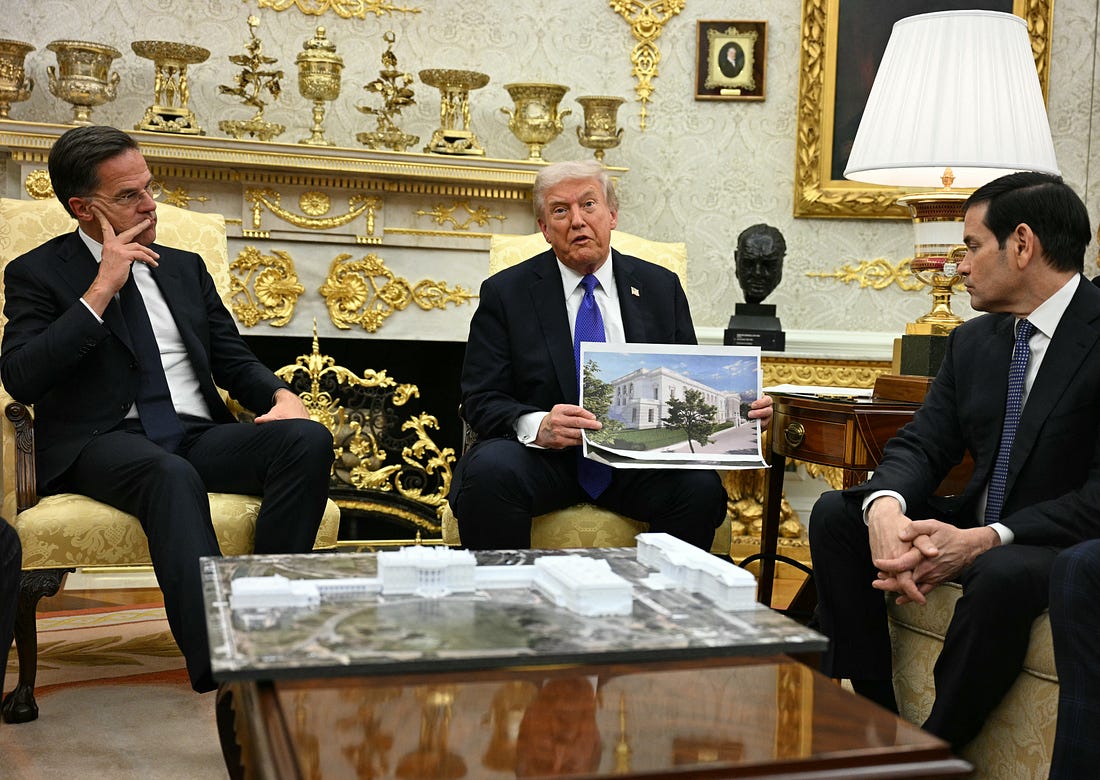


U.S. President Donald Trump shows a rendition of the East Wing of the White House currently being demolished to build a ballroom as he meets with NATO Secretary General Mark Rutte in the Oval Office on October 22, 2025. (Photo by JIM WATSON / AFP via Getty Images.)
The Asbestos Wing

by William Kristol

Here in Washington yesterday, a fine new organization, the Society for the Rule of Law, held a conference on . . . the rule of law. The panel discussions were well attended, the speakers’ remarks excellent, the mixing and mingling at the reception afterwards was lively. The takeaway: One shouldn’t underestimate the speed and thoroughness of the Trump administration’s assault on the rule of law.

Meanwhile, just over a mile away, it was becoming obvious that one shouldn’t underestimate the speed and thoroughness with which the Trump administration was demolishing the entire East Wing of the White House. It’s expected to have disappeared into the literal dustbin of history by this weekend.

You’ll be shocked to learn that in this instance, as in so many others, Trump is breaking a promise. He had said in July that the existing White House wouldn’t be touched by his ballroom construction. “It won’t interfere with the current building. It’ll be near it but not touching it. And pays total respect to the existing building, which I’m the biggest fan of.”

But that pledge by the President is no longer operative. Why not? Well, Trump explained yesterday, the East Wing “was never thought of as being much. It was a very small building.”

Very small is bad. Very big is good. And so Donald Trump decided that the small old East Wing would be summarily replaced by a big new ballroom.

What, you ask, will that grand structure be called? Did you have to ask? According to the pledge agreement sent to donors, they’ll be contributing to the construction of ”The Donald J. Trump Ballroom at the White House.”

The donors seem happy to help. The defense contractor Lockheed Martin is among the companies reported to have pledged at least $10 million. That sum is close to what the company spent in all of 2024 on federal lobbying. Lockheed, which takes in tens of billions in dollars of federal contracts, knows where its bread is buttered—and who in this day and age is doing the buttering. As Jalen Drummond, vice president of corporate affairs, said, “Lockheed Martin is grateful for the opportunity to help bring the President’s vision to reality and make this addition to the People’s House a powerful symbol of the American ideals we work to defend every day.”

The “addition to the People’s House” will cover 90,000 square feet and will dwarf the main White House.

Perhaps that’s appropriate. That old and sedate building was fit for an older Republic governed by the old-fashioned rule of law. But as the presentations at yesterday’s conference emphasized, it’s by no means clear that we still have such a government.

Abraham Lincoln captured the spirit of that old republican government in impromptu remarks to soldiers of the One Hundred Sixty-sixth Ohio Regiment, who stopped in front of the White House on August 22, 1864 on their way home from the war. Lincoln explained why the fight was necessary:


It is not merely for today, but for all time to come that we should perpetuate for our children’s children this great and free government, which we have enjoyed all our lives. . . . I happen temporarily to occupy this big White House. I am a living witness that any one of your children may look to come here as my father’s child has.

That was Lincoln.

Trump, on the other hand, as he sat Tuesday at his desk in his newly gilded Oval Office, looking out on his paved-over Rose Garden, not far from where he plans to build his new imitation of the Arc de Triomphe, said this: “We can never let what happened in the 2020 election happen again. We just can’t let that happen. I know Kash is working on it, everybody is working on it. And certainly Tulsi is working on it. We can’t let that happen again to our country.”

Unlike Lincoln, Donald Trump doesn’t seem to imagine himself a mere temporary inhabitant of the building in which he resides. He apparently doesn’t intend to allow for the defeat of the incumbent administration, and a peaceful transfer of power, in November, 2028.

But at least we’ll be allowed to watch Trump celebrating his triumph over the old republic along with his wealthy enablers in his palatial new ballroom.


Get Morning Shots every weekday:
Join

Proton Mail’s mobile apps just got their biggest upgrade in nearly a decade.


Proton Mail’s mobile apps just got their biggest upgrade in nearly a decade. We rebuilt them from the ground up to be faster, smoother, and more reliable — even offline. And, for the first time, iOS and Android are fully in sync, with the same features and updates arriving side by side. It’s a major step forward for the world’s most widely used encrypted email service.

In this newsletter, you’ll find the highlights from the new Proton Mail apps, plus other recent updates to Proton Calendar and Proton Mail.

Proton Mail, rebuilt for speed

The new, completely redesigned Proton Mail apps for iOS and Android deliver faster and more reliable performance, even if you have to go offline.

  • Everything at your fingertips: A clean new design makes it easier to navigate, with key actions like composing within easier reach.
  • Performance that keeps up: Routine actions, like scrolling your inbox, archiving threads, or replying on the go, all feel instant and are now twice as fast.
  • Offline mode: Read, write, and organize your emails without an internet connection. Sync happens automatically when you’re back online.

Behind the scenes, our Android and iOS apps now share roughly 80% of their code, which means faster development and updates that land within the same release window across both platforms.

Get Proton Mail for iOS
Get Proton Mail for Android

Secure your account with 2FA security keys

You keep important moments of your life in your Proton Account. Whether it’s bank statements you receive in Proton Mail or events you set up in Proton Calendar, your data deserves to be protected.

You can now secure your account with hardware security keys for two-factor authentication (2FA) across the Proton Mail and Calendar apps on all platforms. This ensures only you can access your account using a physical device that you own.

To add a security key, go to SettingsAccount and passwordTwo-factor authentication.

Learn more about hardware security keys

More ways to manage your schedule

Proton Calendar is now available on iPad and also comes with a new compact widget. You can check your schedule at a glance from your home screen and stay on top of events wherever you are.

Get Proton Calendar for iOS

More ways to send with Proton Mail

Your plan now includes SMTP Submission. This lets you send emails directly from external apps and devices — like a printer, smart home setup, or WordPress blog — using Proton Mail’s trusted IPs and anti-spam protections.

Learn more about SMTP Submission

Follow the latest Proton news and privacy tips

Tweet from Proton Mail

Proton helps make protecting your privacy easy. Follow us on Twitter/X to stay updated about our newest feature releases, read the latest privacy news, and get online security tips. You can also join the discussion on Reddit to get in-depth insights directly from our team. If you have ideas about what you’d like to see next in the Proton ecosystem, visit UserVoice to let us know what you’d like us to do next.

Thank you for supporting Proton. With your feedback, we’re building a faster, more powerful, and more private internet.

Stay secure,
The Proton Team