Sign up today

Sign up today
Softphone APP for Android &IOS

RG Richardson Communications News

I am a business economist with interests in international trade worldwide through politics, money, banking and VOIP Communications. The author of RG Richardson City Guides has over 300 guides, including restaurants and finance.

Donald Trump Is a Commie - by Jonathan V. Last

Donald Trump Is a Commie - by Jonathan V. Last

Donald Trump Is a Commie

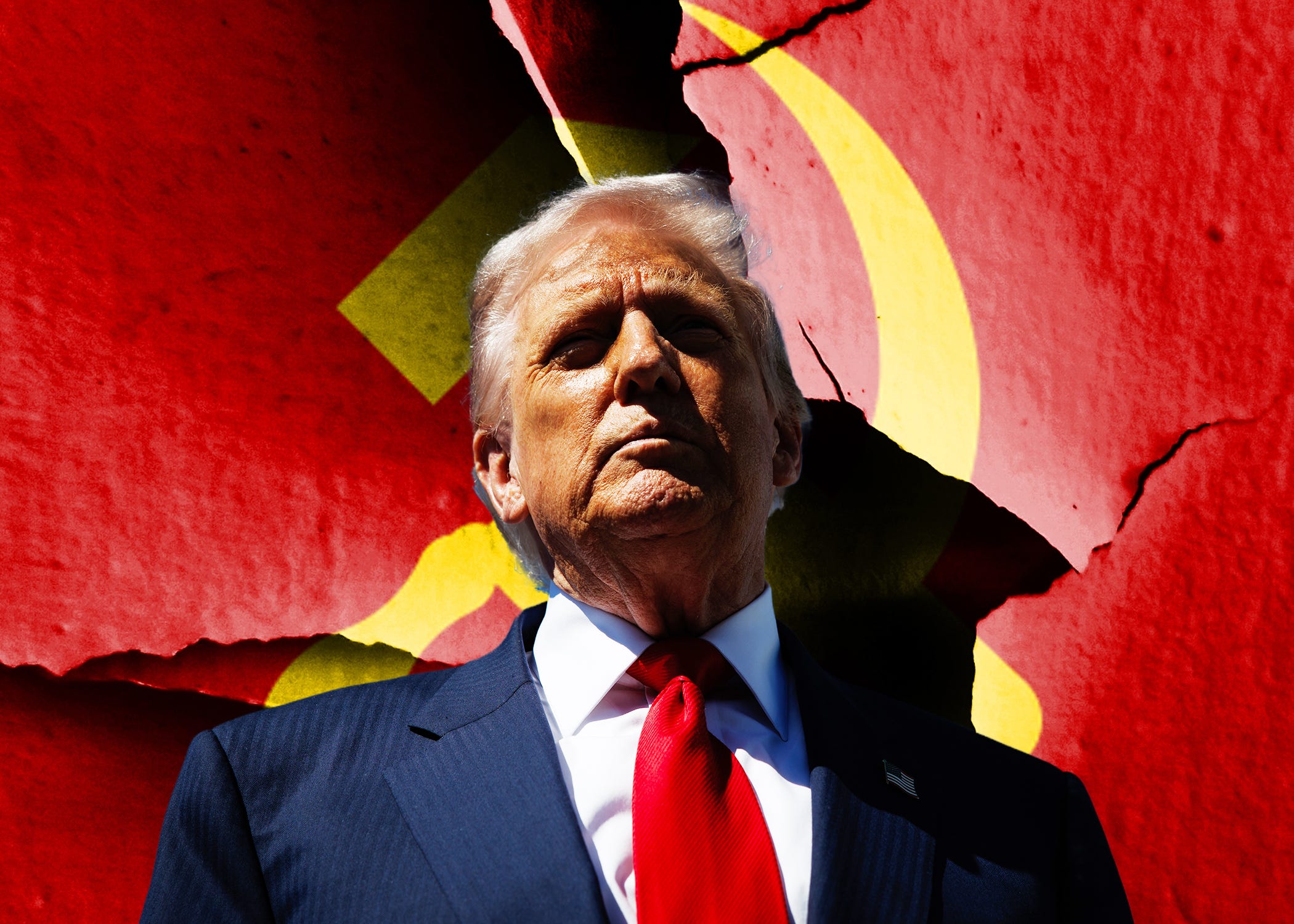
Bernie’s democratic socialism is still compatible with liberal democracy. Trump’s national socialism is not. Thank you for your attention to this matter!

(Composite / Photos: GettyImages /Shutterstock)

1. Two Paths

On Friday I wrote about the Trump administration’s latest foray into national socialism:

  • Trump wants to build nuclear power plants.

  • He has chosen Westinghouse to build them.

  • He will pay Westinghouse $80 billion for the projects.

  • In return he has compelled Westinghouse to pay him the government 20 percent of any “cash distributions.”

  • Between now and the end of January 2029, the government can compel Westinghouse to go public via an IPO, at which point the government will be awarded 20 percent ownership of the company, likely making it the single largest shareholder.

This is literally seizing the means of production. But to, you know, make America great again. Or something.

Other of Trump’s national socialist policies include:

  • Refusing to enforce the 2024 law requiring the sale of TikTok until he was able to compel that the business be sold at an extortionately discounted price to his political allies.

  • Creating a Golden Share of U.S. Steel for his government.

  • Requiring Nvidia and AMD to pay the government 15 percent of all revenues from chip sales to China.

  • Acquiring a 10 percent ownership stake in chipmaker Intel.

  • Acquiring a 15 percent stake in rare earth producers MP Materials, a 10 percent stake in Lithium Americas Corp., and a 10 percent stake in Trilogy Metals Inc.

  • Creating a “Strategic Bitcoin Reserve and Digital Asset Stockpile.”

  • Taking steps to create a sovereign wealth fund to be used as a vehicle for government investment.

  • He has demanded that Microsoft fire an executive he does not like and demanded that private law firms commit to doing pro bono work on behalf of clients he chooses for them.

This is not quite the economic regime of China or Saudi Arabia. But it’s in the same zip code. And it’s heading in their general direction and away from the regulated American free market economy as it had existed until ten months ago.

So why is it so hard for people to just say, out loud, what is obvious: Donald Trump is a socialist who is trying to make the American economy function more like Communist China?

Erebor, a new crypto-focused US bank - Peter Thiel and Palantir


Palmer Luckey gestures with his hands

Patrick T. Fallon/Getty Images

RIP Smeagol, you would’ve hated the idea of precious treasures that no one can physically grasp. And hello to Erebor, a new crypto-focused US bank that received initial federal approval this week, teeing it up to fill a financing gap left by the collapse of Silicon Valley Bank and other tech lenders in 2023.

Erebor—named after a mountain from JRR Tolkien’s universe where a dragon guarded immeasurable riches—was co-founded earlier this year by Palmer Luckey:

  • That’s the guy with a soul patch and mullet who runs the weapons manufacturer Anduril, which is also the name of Aragorn’s sword from The Lord of the Rings.
  • Erebor investors include Joe Lonsdale and Peter Thiel, co-founders of Palantir, the oft-protested software company that…also gets its name from the Tolkien franchise.

Luckey’s new venture will offer traditional and crypto-oriented banking to upstart tech companies and the ultrawealthy, according to its charter application and approval letter. It needs another stamp of approval from more federal officials before operations can commence, but road bumps are unlikely under President Trump’s crypto-friendly administration.

“Palmer’s political network will get this done,” an Erebor fundraising memo promised earlier this year. Luckey, Lonsdale, and Thiel are longtime Trump backers, and an attorney who helped them draft Erebor’s charter application is now chief counsel to the federal official who just granted the bank’s preliminary approval.

Macdonald Campus Magazine tells the story of life in wartime Canada - Julius G. Richardson

Macdonald Campus Magazine tells the story of life in wartime Canada - McGill Reporter

Macdonald Campus Magazine tells the story of life in wartime Canada
Digital archives allow readers to travel back in time more than 100 years
By Neale McDevitt
Editor, McGill Reporter
November 11, 2021
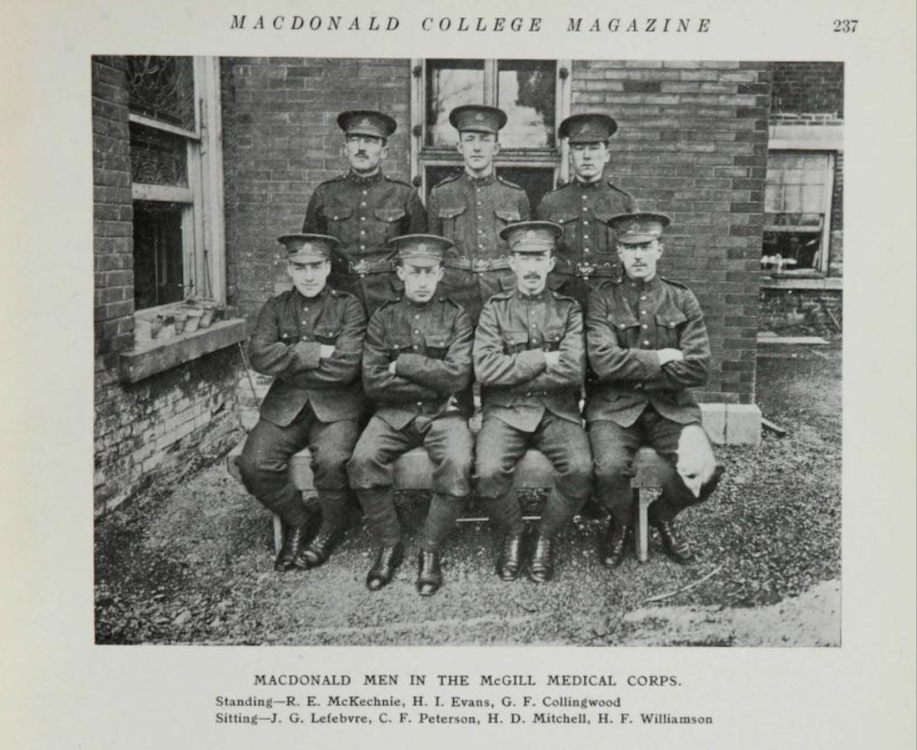
Members of Macdonald College who had enlisted in the McGill Medical Corps. From the February-March 1915 issue of Macdonald Campus Magazine

A quick scan of the table of contents of the October-November 1914 issue of the Macdonald College Magazine, reveals articles one would expect in a publication produced by an agricultural college that also trained teachers. Progressive Farming in Sherbrooke County, Preparing the Flock for Winter, and Music in the Curriculum are typical of the indexed headlines.

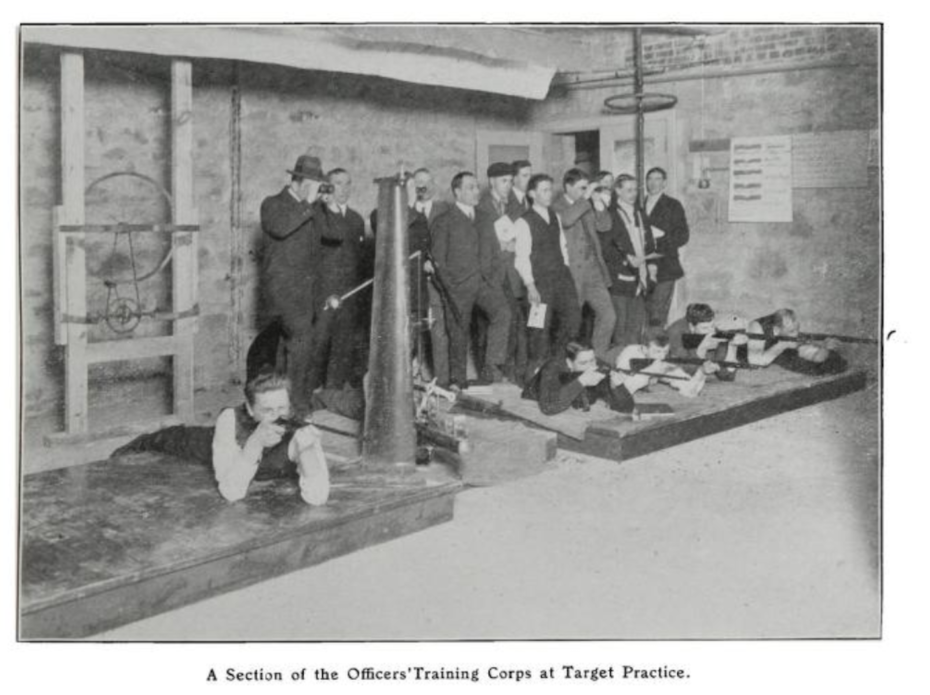
However, on Page 5, a headline unlike any other in the magazine’s (then) four-year history jumps off the page. If War Broke Out!, written by Maurice C. Signoret, asks readers to consider the outcome of a hypothetical war between France and Germany.Members of Macdonald College take target practice as part of the on-campus Officers’ Training Corps

The article ends with Signoret’s chillingly accurate prediction “What will occur in this dreadful contact, in which more than 23 millions of men will take part!” writes Signoret, an Agriculture student at the time. “What will be the hideous butchery, outrage to humanity, the horrible slaughter, to which this fantastic mixtion [sic] will give way, seconded as they will be by frightful engines of artillery, engines of ruin which will make hecatombs of corpses! A terrifying, unimaginable, and, though fatal, unavoidable war, where nations will be dashed by the shock, and in which the revolution, everywhere prepared, will sweep away emperors, kings, their servitors, and the society responsible for such catastrophes!”

Of course, the First World War started on July 28, 1914, several months before the issue was published, and much of Europe was already reeling under the impact of the conflict. However, as clarified in the Editor’s Note, the article was submitted even before war had been declared.

“This article was written last spring by Mr. Signoret for our magazine. Little did we think when he wrote it how terribly true were his words,” noted the editors. “In fact we did not publish it partly because we did not think it best to even hint at such a dire event. He is a Frenchman, and this article has been left for the most part in the original language in which he wrote it. To-day he is nobly fighting for our liberty at the front. May Heaven bring him back to us safe and sound!”

With that, the Macdonald College Magazine added a new beat to its coverage, chronicling the impact of war upon campus life and local and national agriculture, and keeping tabs on the members of its community who had signed up to serve.
Step back in time

To sift through the digital archive of those early wartime issues page by page is to take a fascinating jorney back in time.

Browsing the war year issues, readers will find classic Macdonald College Magazine fare (The Industrial Use of Potatoes) intermingled with news about the war and, in particular, the members of Macdonald College who had enlisted.

“In the fall number of the MAGAZINE we had the honour of inscribing on its pages the names of those who had volunteered for active service in the cause of the Empire. Many of those whose names were given are now doing their part, as we knew they would, in the trenches in France, or in other capacities in keeping with their training and the necessities of war… it behooves us to realize that Macdonald Campus now has representatives in the actual theatre of war,” begins an article titled Macdonald’s Roll of Honour, published in the February-March 1915 issue.

The article captures the closeness of the small Mac community and the pride the members of the College felt for their colleagues overseas. “Not long ago the Principal received a letter from Baily, in which a very vivid account of the life with the mighty army was detailed. MacClintock has also given us, in his usual racy style, an account of things in his own sphere… We honour our boys who for the time being have discarded the pen, the test-tube and the lecture-room to don the khaki of the King, and we await with confidence their return from the field of honour, and of glory. Their sacrifices have been great; great will be their reward.”
The reality of war

Of course, the sacrifices were great.

In all, 357 members of Macdonald College served in the First World War. Thirty-four did not come home.

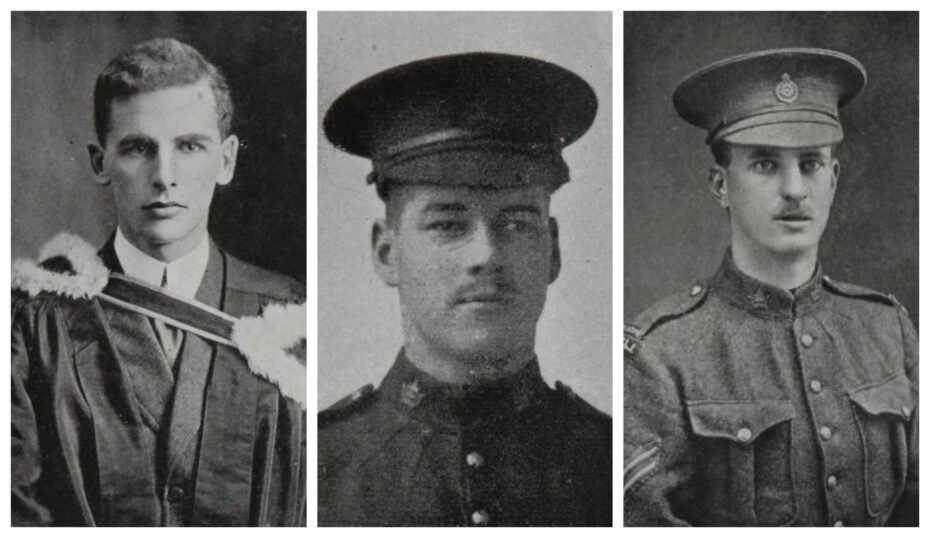
The October-November 1916 issue of the Magazine News carried tragic news. Three members of the Mac community had been killed in Europe – the first such losses for the College.From left to right: W.D. Ford, Julius G. Richardson and James H. McCormick were the first three members of Macdonald College to be killed in action during the First World War

W.D. Ford (BSA’13), was described as “one of the most promising men in his class,” in the Magazine’s obituary, and “one of those rare beings whose keen eyes found no difficulty in descrying the path of duty, whose inherent honesty and nobleness of character permitted him to deviate no hair’s breadth from this path.” A lance corporal in the Canadian Infantry (Eastern Ontario Regiment), Ford, was killed in action at Sanctuary Wood in Ypres on June 2, 1916.

Julius G. Richardson was also killed in Ypres, but on June 7, 1916. Richardson had put his Agriculture degree on hold to enlist, serving as private with the 24th Battalion, Canadian Infantry (Quebec Regiment). “It is difficult for us to realize that our College chum and true friend to all who knew him, will never return,” reads the obituary. “We all looked forward to his coming back to complete his course at Macdonald with us.”

A sergeant in the Princess Patricia’s Canadian Light Infantry (Eastern Ontario Regt.), James H. McCormick, was killed during the Battle of the Somme on September 15, 1916. “Probably no student who has attended this institution had any quicker insight into the intricacies of a subject than he,” says the Magazine’s obituary. “His ability to tell a good story, his jolly laugh, his willingness at all times to help a fellow student through some difficult phase of physics or chemistry, helped him win a multitude of friends, and many a happy hour was spent in his company.”

Read the Macdonald College Magazine / Journal digital archives online, including the issues spanning World War II.

Brazil Greenlights Oil Drilling Near Mouth of Amazon River Ahead of Climate Summit

Brazil Greenlights Oil Drilling Near Mouth of Amazon River Ahead of Climate Summit

Brazil Greenlights Oil Drilling Near Mouth of Amazon River Ahead of Climate Summit
October 29, 2025
Reading time: 4 minutes

Full Story: The Associated Press with files from The Mix
Author: Mauricio Savarese


Petrobras/Wikipedia


After Brazil’s government approved exploratory drilling by state-run oil-giant Petrobras near the mouth of the Amazon River, environment groups say the decision is “an act of sabotage,” coming weeks before the United Nations climate conference in Belem, COP30, where efforts to reduce the use of fossil fuels will be discussed.

The Equatorial Margin deposit off the coast of Brazil, which stretches from Brazil’s border with Suriname to a part of the country’s Northeast region, is believed to be rich in oil and gas. The biodiverse area is home to little-studied mangroves and a coral reef, and activists and experts have said the project risks leaks that could be carried widely by tides and imperil the sensitive environment. Petrobras has long argued it has never caused spills in its drillings.

The decision was made by environmental regulator IBAMA, run by the country’s environment ministry. In May 2023, that same body declined to grant Petrobras a license to drill in that region.

“After the refusal… IBAMA and Petrobras started an intense discussion that allowed a meaningful improvement of the project, especially in its structure of responding to emergencies,” the environmental regulator said in a statement.

Petrobras said in a Oct. 20 statement that the drilling could start right away and take up to five months. It requested to conduct the exploratory drilling in block FZA-M-059, which lies 175 kilometres offshore the northern Brazilian state of Amapa bordering Suriname. The company added that the exploratory well will not produce any oil.

“The approval is an act of sabotage against the COP and undermines the climate leadership claimed by President Luiz Inácio Lula da Silva,” Climate Observatory, a network of environmental organizations from Brazilian civil society, said in a press release, adding that civil society organizations would go to court over illegalities and technical failures in the licensing process.

And they did. In a lawsuit filed against Ibama, Petrobras, and the Brazilian government, eight organizations requested the annulment of the environmental license granted to the oil giant, on the grounds that the licensing process bypassed Indigenous peoples and traditional communities, had serious modeling flaws that endanger biodiversity, and ignored the project’s climate impacts.

Energy Minister Alexandre Silveira celebrated the exploration approval as a way to defend “the future of our energy sovereignty.”

“Brazil cannot give up knowing its potential,” Silveira said on his social media channels after the decision was announced. “We made a firm and technical defense (of the drilling in the region) so we can assure that the exploration takes place with complete environmental responsibility, within the highest international standards and concrete benefits for Brazilians.”

In June, Brazil auctioned off several potential land and offshore oil sites near the Amazon River, as it aims to expand production in untapped regions despite protests from environmental and Indigenous groups.

Nineteen offshore blocks were awarded to Chevron, ExxonMobil, Petrobras and China National Petroleum Corporation. The oil companies see the area as highly promising because it shares geological characteristics with Guyana, where some of the largest offshore oil discoveries of the 21st century have been made.

This region is considered to have high potential risk due to strong currents and the proximity to the Amazon seashore. Block FZA-M-059 lies 500 kilometers (310 miles) north of the mouth of the Amazon River.

Suely Araújo, a coordinator at the Climate Observatory, a network of environmental nonprofit groups, said Brazil’s government “acts against humanity by stimulating more expansion of fossil (fuels), and betting on more global warming.”

“It also harms COP30 itself, whose most important delivery needs to be the gradual elimination of fossil fuels,” Araújo said in a statement.

President Luiz Inácio Lula da Silva pushed for more use of biofuels during his first two terms, from 2003 to 2010, but that standing waned throughout those years after huge offshore discoveries close to Rio de Janeiro state became a means of financing health, education and welfare programs. The soon-to-be 80-year-old leftist leader is widely expected to run for reelection next year.

This Associated Press story was published Oct. 20, 2025 by The Canadian Press


BlackRock-linked tokenization firm Securitize to go public via SPAC deal

BlackRock-linked tokenization firm Securitize to go public via SPAC deal


BlackRock-linked tokenization firm Securitize to go public via SPAC deal
Published Tue, Oct 28 20257:01 AM EDT

Liz Napolitano@LizKNapolitano
ShareShare Article via FacebookShare Article via TwitterShare Article via LinkedInShare Article via Email
Key Points
The fintech firm will merge with Cantor Equity Partners II, Inc., a blank-check company sponsored by an affiliate of Cantor Fitzgerald.
The deal values Securitize’s business at $1.25 billion in pre-money equity.
Following the merger, the combined entity Securitize Corp.’s stock will trade on the Nasdaq under the ticker symbol SECZ.


Carlos Domingo, chief executive officer of Securitize Inc., speaks during the Messari Mainnet summit in New York, US, on Thursday, Sept. 21, 2023. Photographer: Michael Nagle/Bloomberg via Getty Images
Bloomberg | Bloomberg | Getty Images


Securitize, the “real world assets” platform that powers BlackRock’s tokenized money market fund, will go public through a merger with a special purpose acquisition company, CEO Carlos Domingo told CNBC in an exclusive interview.

The fintech firm will merge with Cantor Equity Partners II, Inc., a blank-check company sponsored by an affiliate of Cantor Fitzgerald that trades under the CEPT ticker. The deal values Securitize’s business at $1.25 billion in pre-money equity.


“Tokenization is what everybody’s talking about … but there’s nobody publicly traded that does it,” Domingo told CNBC. “We will do well in the public market because people want to index themselves to tokenization the same way that people are buying Circle because they want to index themselves to stablecoins.”

Tokenization refers to the registration of ownership rights to real-world assets such as stocks, bonds or gold on a blockchain. The process enables more transparent and around-the-clock trading versus traditional methods, according to its proponents — among whom are Robinhood Markets CEO Vlad Tenev and BlackRock CEO Larry Fink.

Following the merger, the combined entity Securitize Corp.’s stock will trade on the Nasdaq under the ticker symbol SECZ. Shares could begin trading on the exchange as soon as January, according to Domingo.

The company will book $465 million in gross proceeds from the deal. That includes $225 million from private investors including Borderless Capital and Hanwha Investment, and $240 million in the SPAC’s trust account, assuming no redemptions.
RWA tokenization takes off


The deal comes as tokenized RWAs boom. The combined market value of tokenized U.S. Treasurys has climbed to roughly $8.6 billion as of writing time, up more than 200% over the past year, according to data provider RWA.xyz.


The RWA tokenization market as a whole has ballooned 135% over the past year and is now worth $35 billion, the data shows. Citi analysts see massive growth for the tokenized RWA market, saying it could grow to almost $4 trillion by 2030.

That positions Securitize — which Domingo says has been profitable in recent quarters — to jump into the fray of firms aiming to capitalize on growing demand for digital assets. Earlier this year, Circle debuted on the New York Stock Exchange, raising about $1.1 billion in its blockbuster IPO. Cryptocurrency exchanges Gemini and Bullish also went public earlier in 2025.

Tapping public markets will create winners and losers as the digital asset space continues to grow and mature, Domingo added.

“The crypto industry needs to consolidate,” he said. “If you’re publicly traded and you have access to stock capital markets as well as cash, you can be on the side that is consolidating and not be consolidated by somebody else.”
‘A better ledger’


Founded in 2017, Securitize has facilitated several large financial firms’ first forays into tokenized funds.

In March 2024, BlackRock launched its USD Institutional Digital Liquidity Fund (BUIDL) on the Ethereum blockchain in partnership with Securitize, enabling qualified investors to digitally hold U.S. Treasurys and earn yield. The firm has also tokenized more than $4 billion in assets through partnerships with Apollo, Hamilton Lane, KKR and VanEck on their tokenized funds.

Securitize is the largest tokenization platform, dominating 20% of the RWA tokenization market, per RWA.xyz.

The company plans to also digitize its own equity, a move designed to demonstrate how the public company process and trading can move on-chain, Domingo told CNBC. The executive sees a future in which everything is brought on-chain.

“There’s $400 trillion out there of assets that could potentially be tokenized,” Domingo said. “It’s an upgrade … within the next five to 10 years, you will see everything will be on-chain, because it’s just a better ledger.”