Sign up today

Sign up today
Softphone APP for Android &IOS

RG Richardson Communications News

I am a business economist with interests in international trade worldwide through politics, money, banking and VOIP Communications. The author of RG Richardson City Guides has over 300 guides, including restaurants and finance.

There'll be no iPhone 18 launch this year


Secure Proton eMail

 Proton Mail: https://go.getproton.me/aff_c?offer_id=7&aff_id=13658 I never intended to switch away from Gmail. But I went ahead and set up an account with Proton Mail anyway, and I haven’t opened Gmail since.


The Politics of Plunder


The Politics of Plunder
Trump’s domestic and foreign policies have one consistent theme.


WILL SALETAN, CATHY YOUNG, ANDREW EGGER, SAM STEIN, AND JIM SWIFT


DEC 26

READ IN APP

MAGA Christmas was a choose-your-own-adventure affair this year. Did you want to hear Donald Trump wax eloquent, in what is definitely his own writing, about “the graces of Christ’s life, death, and resurrection” that “pour out on all who believe”? Just head over to his “Presidential Message on Christmas,” posted to the White House website. Are you the sort who found all that a little pious and drab? You might find Trump’s Truth Social message a little more your speed:
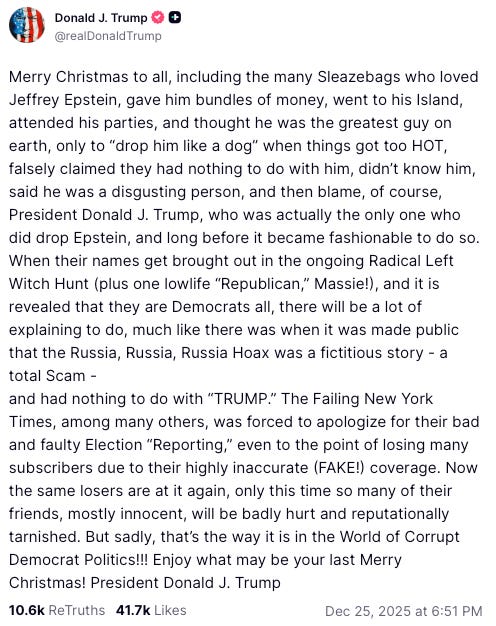


Joy to the World! Happy Friday.
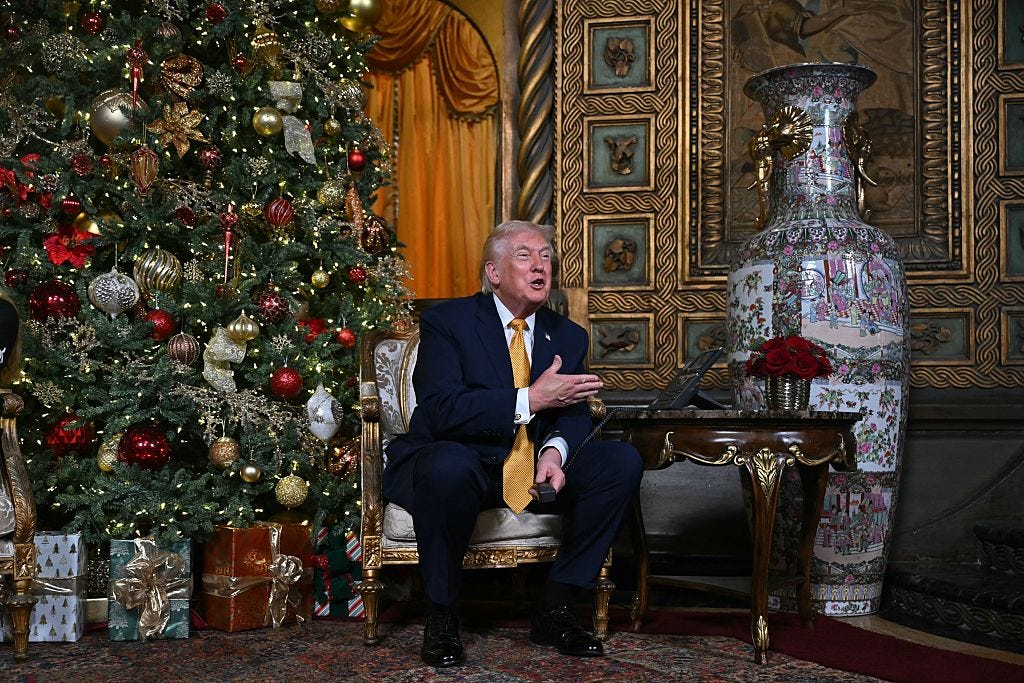


President Donald Trump on Christmas Eve at his Mar-a-lago club in Palm Beach, Florida. (Photo by ANDREW CABALLERO-REYNOLDS / AFP via Getty Images)
The President Is a Pirate

by Will Saletan

Donald Trump calls himself the “Peace President.” But this week, as he outlined his plans to capture Greenland and hijack Venezuelan oil, his real agenda became obvious. It’s not peace. It’s extortion, conquest, and theft.

Trump spent his life pursuing wealth, not public service. As president, he reduces every question to money. He arm-twists companies into giving the government a chunk of their stock. He withholds food stamps as a bargaining chip. He calls low-income housing an offense against rich people. He muses about awarding himself $1 billion from the Treasury.

He treats international relations the same way. He slaps our allies with heavy tariffs, insisting that they “pay for the privilege of access to our market.” He bails out Argentina, meddles in its election, and then brags that his candidate’s victory “made a lot of money for the United States.” He bars immigrants from “third world countries” and sells visas to multimillionaires instead.

He also exploits war. Two months ago, in a speech to American troops in Japan, he fondly recalled the days when “they used to say, ‘To the victor belong the spoils.’” In more recent wars, he complained, “We’d win, and then we’d leave.” He made it clear that he would restore the doctrine of spoils. “Unlike past administrations, we will not be politically correct,” he told the troops.

In some parts of the world, Trump has cashed in on the use of force by other countries. In February, after Israel had leveled much of Gaza, he announced a plan to seize the territory, “own it,” and develop it into “the Riviera of the Middle East.” A reporter asked the president whether he truly meant permanent occupation. “I do see a long-term ownership position,” Trump replied.

In Ukraine, Trump has taken advantage of Russia’s invasion. By choking off Ukraine’s access to military aid and intelligence, he extracted Kiev’s agreement to give much of its mineral wealth to the United States. “I made a deal to take rare earth,” he boasted. “That’s the equivalent of much more” than the aid Joe Biden had sent to Ukraine, he said.

Trump also found a second revenue stream from the war: selling weapons to NATO—at “full price”—which NATO would then deliver to Ukraine. “We’re making money,” he told reporters. “We have the hottest company,” he added a minute later. Then, catching his slip, he corrected the last word to “country.”

Like Vladimir Putin, Trump has concocted grievances to justify aggression against other nations. In his inaugural address, he vowed to seize the Panama Canal, claiming that Panama had violated its 1977 agreement to keep the canal neutral. Then, in a bid to annex Canada, he threatened to choke off that country’s foreign trade. To rationalize his coercion, he alleged that Canada “stole” its auto industry from the United States.

Now Trump has deployed the Navy, the Coast Guard, and other forces to harass and intimidate Venezuela. Last week, he issued an ultimatum, warning that the military buildup would continue until Venezuelans “return to the United States of America all of the Oil, Land, and other Assets that they previously stole from us.”

Trump’s tales of oil and land theft apparently date to 1976, when Venezuela nationalized its oil industry. As usual, he’s wrong—American companies didn’t own any of Venezuela’s land or oil—but he’s plotting to capitalize on his propaganda. On Monday he said he had spoken to “all the big” U.S. oil companies about returning to Venezuela once the current government, under American pressure, is ousted.

And oil companies aren’t the only ones who stand to profit. Last week, Sen. Mike Lee of Utah, a Trump ally, introduced legislation authorizing “private American citizens and their businesses” to confiscate boats and other alleged property of drug cartels.

Meanwhile, after months of hectoring Greenland to separate from Denmark and join the United States—under threats of tariffs and military force—Trump announced on Monday that he had appointed a special envoy whose self-described assignment was to “make Greenland a part of the U.S.” Trump dismissed Denmark’s sovereignty over Greenland, scoffing, “They say that Denmark was there 300 years ago or something with a boat. Well, we were there with boats, too, I’m sure.”

This isn’t the foreign policy many of Trump’s voters wanted. They thought “America First” meant staying home. Instead, Trump has gone abroad to seize land and treasure. He’s a pirate. And being a pirate is all fun and games until somebody loses an island.

Requirements for Porting Your Number

 Requirements for Porting Your Number


To successfully port your number, make sure you meet the following conditions: An eligible phone number for porting, as certain prepaid numbers might not qualify. No prior cancellation of the number (your current service must still be active) An account in good standing with no unpaid balances. The exact account holder name and billing address as registered Your account number and, if applicable, a PIN or password A copy of your recent bill (some providers may request this for verification)

Providing accurate information is key. Incomplete or incorrect details can delay the porting process or even result in a rejected request from your new carrier.
Why Port Your Number to a VoIP Provider?

Porting your phone number to a VoIP provider is a smart upgrade that offers long-term benefits for both individuals and businesses.

Here’s why making the switch is worth it:
Keep your existing phone number

Switching providers no longer means losing your number. With number porting, you can move to a VoIP service with better pricing or features without disrupting your business contacts or workflows.
Unlock advanced features for productivity

VoIP systems come with powerful tools like auto-attendants, call routing, voicemail-to-email, and SMS support. These features improve efficiency and enhance your team’s communication, all while reducing operating costs.
Simplify your communications

Whether you’re running a business or managing personal calls, keeping your number ensures consistency for clients, family, and stakeholders.
Save time and money on updates

Ashley MacIsaac concert cancelled after AI wrongly accuses him of being sex offender | CBC News

Ashley MacIsaac concert cancelled after AI wrongly accuses him of being sex offender | CBC News

Ashley MacIsaac concert cancelled after AI wrongly accuses him of being sex offender
'I'm telling you, this is not a nice place to be,' he told CBC News
The Canadian Press · Posted: Dec 23, 2025 1:39 PM PST | Last Updated: December 24


Cape Breton fiddler Ashley MacIsaac said 'I'm not the first and I'm sure I won't be the last,' after a Google AI-generated summary mistakenly confused him with someone else with the same last name. (Kelly Clark/The Canadian Press)

Social Sharing

X

Email

Reddit

LinkedIn


Cape Breton fiddler Ashley MacIsaac says he may have been defamed by Google after it recently produced an AI-generated summary falsely identifying him as a sex offender.

The Juno Award-winning musician said he learned of the online misinformation last week after a First Nation north of Halifax confronted him with the summary and cancelled a concert planned for Dec. 19.

"You are being put into a less secure situation because of a media company — that's what defamation is," MacIsaac said in a telephone interview with The Canadian Press, adding he was worried about what might have happened had the erroneous content surfaced while he was trying to cross an international border.


"If a lawyer wants to take this on (for free) ... I would stand up because I'm not the first and I'm sure I won't be the last."

MacIsaac said the summary falsely asserted he had been convicted of a series of offences including sexual assault, internet luring, assaulting a woman and attempting to assault a minor. As well, he said the Google entry accused him of being listed on the national sex offender registry, which is also untrue.

"I could have been at a border and put in jail," he said. "So something has to be figured out as far as what the AI companies are responsible for ... and what they can prevent."

MacIsaac performed at the 2013 East Coast Music Awards in Halifax. (Andrew Vaughan/The Canadian Press)
First Nation apologizes

The 50-year-old virtuoso fiddler said he later learned the inaccurate claims were taken from online articles regarding a man in Atlantic Canada with the same last name.

Google Canada spokesperson Wendy Manton issued a statement saying Google's "AI overviews" are frequently changing to show what she described as the most "helpful" information.
With gigs dried up, Cape Breton's Ashley MacIsaac wants to play in your living roomFamed fiddler Ashley MacIsaac first to buy legal marijuana in Cape Breton

"When issues arise — like if our features misinterpret web content or miss some context — we use those examples to improve our systems, and may take action under our policies."

Meanwhile, the Sipekne'katik First Nation issued a public apology to MacIsaac, saying in an online post that the cancellation was based on incorrect information.

"We deeply regret the harm this caused to your reputation and livelihood," the message says. "Chief and council value your artistry, contribution to the cultural life of the Maritimes, and your commitment to reconciliation."

As for the cancelled concert, MacIsaac says he's looking forward to rescheduling the event. But he said he wanted things to settle down before setting a date.
People reading AI summaries on Google search instead of news stories, media experts warnTop AI assistants misrepresent news content, study finds

"I don't feel comfortable about going there right now because I don't think the proper information can be disseminated within a week. It's seen so many shares," he said. "I didn't want to bring any attention negatively to the community."


He speculated about how the misinformation might have prompted the cancellation of a concert scheduled for earlier this year in Mexico.

MacIsaac said he doesn't have the money to pay for a lawsuit that could take years to settle.

But when CBC News reached him by phone on Christmas Eve, he said he'd already received queries from law firms across the country interested in taking it on pro bono.

He says he's considering his options in the hopes that he can prevent other people from experiencing something similar in the future.

“I'm telling you, this is not a nice place to be," he said. "I'm sitting outside my grandmother's going in for Christmas. This isn’t a conversation I want to have today — 'Oh, yeah, somebody called me a sex offender.'”
No stranger to controversy

MacIsaac burst onto the music scene in the 1990s as a wildly talented teenager who blended traditional Celtic music with a high-energy, rocking style.

To be sure, he is no stranger to controversy.

During a 1999 concert in Halifax, he launched into a profanity-laced rant that ended the show and resulted in widespread cancellations of his gigs. And in early 1997, he attracted attention for discussing his sexual proclivities with a reporter and flashing his private parts during an appearance on a late-night U.S. talk show.
WATCH | MacIsaac buying pot in 2018:


First to buy 'in God's country': Ashley MacIsaac talks his pot purchase
October 17, 2018|
Duration0:57Fiddler Ashley MacIsaac was the first to buy legal cannabis in Cape Breton on Wednesday. He discusses what he bought.

But he hasn't had any real run-ins with the law, aside from receiving an absolute discharge and no fine in 2001 for possessing marijuana in Saskatchewan. When Judge Linton Smith granted the discharge, he told MacIsaac's lawyer, "The only condition I'd like to attach is if you could get my wife an autograph."

When cannabis was legalized in Canada in October 2018, MacIsaac was the first in line at a Nova Scotia Liquor Corp. branch in Cape Breton, which was about to become the only legal place to buy recreational cannabis on the island.


"I don't need to be a criminal anymore, and that's a great feeling," he said at the time. "And my new dealer is the prime minister!"

Federal judge upholds $100,000 H-1B visa fee

Federal judge upholds $100,000 H-1B visa fee

A federal judge on Tuesday ruled in favor of the Trump administration, upholding its $100,000 H-1B visa fee.

U.S. District Judge Beryl Howell rejected a challenge filed by the U.S. Chamber of Commerce and the Association of American Universities, which alleged the move was unlawful. Earlier this month, 18 Democratic states also filed a lawsuit against the Trump administration over the H-1B visa application fee.


Pirates descend on Spotify’s entire library


Illustration of Spotify logo prodded by robot arms and magnifying glass

Niv Bavarsky

The world’s biggest music streaming service got scraped like bare knees on asphalt. A pirate activist group called Anna’s Archive allegedly pulled 300 terabytes of data from Spotify, creating what might be the largest open-music database ever, Billboard reported on Sunday.

According to a blog post from the anonymous group:

  • The scrape includes ~99.6% of songs that actually receive listens on Spotify (about 86 million tunes).
  • It also swiped metadata (e.g., album art and song titles) from 99.9% of Spotify’s 256 million total tracks.
  • The metadata has been released, with music files to follow soon.

Spotify said in a statement that it “disabled the nefarious user accounts that engaged in unlawful scraping,” “implemented new safeguards,” and is “actively monitoring for suspicious behavior.”

Anna’s Archive is a shadow library, aka an online database of pirated content, with a stated mission of “preserving humanity’s knowledge and culture.” It referred to the Spotify scrape as an attempt to start preserving music, after having mainly targeted books and academic papers before.

But…the data dump is likely also a big win for AI developers, as long as they don’t get caught using it. This year, Anthropic agreed to pay $1.5 billion after a federal judge found that it wrongfully acquired pirated books to train its chatbots.—ML

My Latest Letter to CBS

My Latest Letter to CBS

By Ben Meiselas

Dear CBS News Editor Bari Weiss,

This is the second letter I am writing you and the third letter I have sent CBS warning about the dire consequences of the actions being taken. We previously wrote when Stephen Colbert’s contract was not renewed and when you killed the 60 Minutes episode on Trump torturing people in CECOT in El Salvador. I am writing again based on the recent videos and posts made by CBS announcing that the “new CBS” is launching in 2026.

According to the recent videos and posts, the new CBS will not focus on experts, scholars, scientists, and facts, but will instead be driven by the voices of its perceived audience. You have previously described the voices of your audience as resembling Trump’s lawyer, Alan Dershowitz. That is very odd and dangerous, in my opinion.

The recent posts announcing the “relaunch” of CBS have been widely mocked. Your viewership appears to be down massively. In record time, you’ve destroyed the legacy of a great news institution that I admired my entire life until recently. This is all the more ironic, given that you built a successful Substack before others joined this platform, only to cause serious harm to your Substack community and destroy a legacy media brand like CBS.

Your loss is our gain. Your “relaunch of CBS” is only leading to more people subscribing to this MeidasTouch Substack. If you want to know where your audience is going, Bari, they are coming here to the MeidasTouch Substack and to our YouTube channel.

Although your failures and destruction of CBS have resulted in further accelerating the growth of MeidasTouch, I still hate to see CBS fall this badly. I still hope one day that it can be restored to operating with integrity and not whatever it’s doing now.

As 2026 kicks off, it is a responsibility I take seriously that the MeidasTouch Network is now watched significantly more than CBS. We have a bigger audience because our reporting is fact-based and we are not afraid of this regime. Whereas CBS has bent the knee, MeidasTouch will report fearlessly in 2026. I guess we will see you on the other side of this, CBS. You do you, and Meidas will keep on growing.

A quick reminder to everyone: make sure to subscribe now to this Substack and send a strong message in 2026 and help Meidas expand and grow.

Olympic sailing shakeup: Breaking down the new Olympic sailing format

Olympic sailing shakeup: Breaking down the new Olympic sailing format


Yachting World · 11 days ago
by Toby Heppell · Comment and opinion


Matt Sheahan reports on the new Olympic sailing format, which see the Medal Race replaces with a new system (and not the winner-takes-all options so decried by many)Paris 2024 Olympic Sailing Test Event, Marseille, France. Day 3 Race Day on 11th July 2023.

Most of us are off the water and counting down the weeks to the start of the new season as the northern hemisphere delivers this season’s offering of short days, long nights and hardcore weather systems that slide across the Atlantic. But for some, the training programme continues as they focus on the road to the next Olympic Games in Los Angeles in 2028.

Many have headed to warmer locations to train where they often buddy up with some of their arch rivals to compete as if the Games were on in a few weeks. It’s a mark of just how important the summer of 2028 is. But also the importance of how one specific day could play out.

And while the Olympic medal race day is more than two and a half years away, it’s not just their performance that’s important either, the specific details as to how the competition will be run is crucially important. Not only do athletes and coaches need to know how gold, silver and bronze medals will be decided, but they also want to ensure they can maximise their chances of getting to that point.

Understanding the Olympic format may sound obvious but, as I wrote recently, the mooted plans for the next Games looked very different.

For many sailors the proposals put far too great an emphasis on a single short race that would take no account of their performance in the selection series. The worry was that, despite years of training and a string of good results, victory would come down to one extremely short race in an area that could likely have more variable conditions.

And any points buffer they’d built during the series beforehand would be scrubbed in favour of a winner-takes-all single race.

Sailors were so concerned at the little – if any – word from World Sailing as to what was on the table, that they made a fair bit of noise about it leading up to the World Sailing conference. Now it seems, things have changed.


Photo: Mark Lloyd/World Sailing

Following that conference in Dublin significant modifications to the medal races have been made and agreement reached to provide two interesting new formats: one for windsurfing and kites; the other for the dinghy, skiff and multihull classes.

For the windsurfers and kites it looks to be a fairer system than that which existed for the last Games.

After a selection series, the top 10 competitors head into quarter-, semi- and grand finals. In the quarter-final, places 6 to 10 race against each other in a single race with the winning two proceeding to the semi-final to join places 3-5. From this race the winning pair go to the grand-final to race against the top two.

The advantage of this system is that taking the top two from each stage is considered to be better than taking just the winner, as it should both change the tactics and reduce the influence of a lucky win.

In the final with four competitors, the top two start with a win apiece, the other two start on zero. From here the first competitor to achieve two wins takes gold with silver and bronze decided on the number of wins. Under this system it seems more likely the winner will be the dominant/consistent performer in the series.

The format for the sailing classes is a bolder change.

Here, the opening series of 8-9 races seeds the fleet as usual, with the top 10 going through to finals day. The difference is that once the selection series is completed the total points for the top 10 are adjusted (if required), to ensure no competitor is more than 9 points ahead of the next placed competitor. From 4th to 10th position, no competitor can be more than 18 points behind 3rd.

With this compressed points board, all 10 sailors then go into the final (which consists of two single-point races), with a chance of winning a medal. Closing the points gap should mean the racing is more exciting while also allowing a team that has been dominant to maintain a points advantage (the previous idea had been to wipe the scoreboard back to zero ahead of the medal race.)

The new formats will be trialled in a number of the major Olympic classes events this season, the first being the Trofeo Princesa Sofía regatta in Mallorca in late March.

So, while the sailors are relieved that the most important regatta in the world should still rely on a consistent performance, the chances are this coming season will be scrutinised far more than before.
If you enjoyed this….
Yachting World is the world’s leading magazine for bluewater cruisers and offshore sailors. Every month we have inspirational adventures and practical features to help you realise your sailing dreams.

Build your knowledge with a subscription delivered to your door. See our latest offers and save at least 30% off the cover price.

Note: We may earn a commission when you buy through links on our site, at no extra cost to you. This doesn’t affect our editorial independence.

The post Olympic sailing shakeup: Breaking down the new Olympic sailing format appeared first on Yachting World.

United States unlawful invasion of Venezuela today

 Warmonger's illegal invasion.

The United States began a full-scale military operation against Venezuela early Saturday morning. We’ll call it what it is: an unlawful invasion.

US President Donald Trump says Venezuela’s Nicolas Maduro has been captured after US conducted a "large-scale strike" on the South American country.

US President Donald Trump has confirmed US strikes on Venezuela on Saturday and said President Nicolás Maduro and his wife were "captured and flown out of the country," in a post on his social media platform Truth Social.

"The United States of America has successfully carried out a large-scale strike against Venezuela and its leader, President Nicolas Maduro, who has been, along with his wife, captured and flown out of the country," Trump said.

"This operation was done in conjunction with US law enforcement. Details to follow," he added.

"There will be a news conference today at 11 am (5 pm CET) at Mar-a-Lago. Thank you for your attention to this matter! President Donald J Trump."

At least seven explosions and low-flying aircraft were heard around 2 am local time Saturday in Venezuela’s capital, Caracas, according to initial reports.

Venezuela’s government accused Washington of attacking civilian and military installations in multiple states. It said attacks took place in the cities of Caracas, Miranda, Aragua and La Guaira.

Jim Beam to pause production at Kentucky distillery for 2026

 Jim Beam to pause production at Kentucky distillery for 2026. The bourbon-maker said it would halt production at its main facility in Clermont, KY, for at least a year as of Jan. 1. It’s opting for a dry January (and rest of the year) at the distillery as bourbon supplies have increased despite US adults slowing their drinking, and as retaliation against President Trump’s tariffs has injected uncertainty into sales abroad. Distillers must calculate how much bourbon to make since it has to age in barrels for years before being bottled and sold—and the state of Kentucky charges taxes on those barrels. Suntory-owned Jim Beam said it would use the time to make improvements at the distillery. The company said the plant’s workers would be reassigned.—AR


Carney DOMINATES Trump as LEADER OF THE YEAR 2025

In this video, we break down why Carney is being celebrated as the stan Mark Carney has just been officially named The Canadian Press Newsmaker of the Year, and political analysts are calling his first year in power nothing short of historic. This is not a symbolic title. This is Canada’s major newsrooms and political experts acknowledging that no leader shaped Canadian politics — and Canada’s global position — more than Carney this year. In this video, we break down why Carney is being celebrated as the standout global political leader of 2025, how his shocking rise to power stunned critics, and why analysts believe his leadership has fundamentally reshaped Canada’s political and economic future. From rebuilding confidence at home to navigating Trump, international trade tensions, economic instability, and global uncertainty, Carney’s first year is being described as unprecedented in Canadian political history. This isn’t just praise. This is recognition of transformation, strength, and leadership at a moment when Canada — and the world — needed it most. Stay tuned with Canada Today for powerful storytelling, sharp analysis, and the truth behind every headline. Mark Carney Newsmaker of the Year recognition from the Canadian Press confirms what many political analysts are saying: this has been a historic year. With Carney’s first year as Prime Minister dominating Canada political news 2025, experts describe a Carney historic year defined by leadership success, stability, and global influence. As Canada Today politics coverage highlights, Carney beats political odds, earns global leader recognition, strengthens Canada government stability, reshapes Canadian politics, and leads confidently through the Carney vs Trump era leadership challenges — marking a truly unprecedented rise in Canadian history.

Pentagon Hoards Critical Minerals That Could Power the Clean Energy Transition

Pentagon Hoards Critical Minerals That Could Power the Clean Energy Transition

Pentagon Hoards Critical Minerals That Could Power the Clean Energy Transition
December 20, 2025
Reading time: 3 minutes

Full Story: Grist
Author: Sophie Hurwitz


David B. Gleason/Wikimedia Commons


This story was originally published by Grist. Sign up for Grist’s weekly newsletter here.

Pete Hegseth, who has taken to calling himself the Secretary of War, says the U.S. Defense Department “does not do climate change crap.” Just last week, he asserted that the agency “will not be distracted” by climate change or “woke moralizing.”

But a new report suggests the Pentagon is engaging with the issue in one serious way: As it stockpiles dozens of critical minerals, it is threatening the energy transition by hoarding resources that could be used to decarbonize transportation, energy production, and other sectors.

Donald Trump’s One Big Beautiful Bill Act allocated $7.5 billion to bolster the Pentagon’s reserves of critical minerals like cobalt, lithium, and graphite that are held in six depots nationwide, an effort supervised by the Defense Logistics Agency. Such materials are used in everything from jet engines to weapons systems, and often are mined or processed in China or other nations. The materials in the stockpile are only accessible during times of declared war, or by order of the Undersecretary of War, a Defense Logistics Agency spokesperson said.

A report on potential peaceful uses for those materials was released by the Transition Security Project, which analyses the economic, climate, and geopolitical threats posed by the U.S. and British military. Lorah Steichen, a strategist who prepared the document, said America is essentially facing a choice between missiles and buses. The Pentagon’s planned cobalt and graphite stockpiles (7,500 tonnes and 50,000 tonnes, respectively) could electrify 102,896 buses—dwarfing the 6,000 or so currently operating in the U.S. Or they could be used to produce 80.2 gigawatt-hours of battery capacity, which is more than twice the energy storage the country has now.

The International Energy Agency also has said such minerals could be used for peaceful ends, like building the batteries, wind turbines, and other technologies underpinning the green transition. But designating a mineral as “critical” allows the government to fast-track mining and procurement for military ends.

“The term ‘critical minerals’ originates out of military stockpiling—the criticality of a mineral is linked, in part, to its significance to national security,” Steichen said.

The last time the Pentagon hoarded non-fuel materials was during the Cold War, when the government sought to create storehouses of industrial raw materials (like metals and agricultural supplies) and limit dependency on other nations. By the late 1990s, the United States began to see other countries—particularly those in the Caribbean—as generally reliable suppliers, and by 2003 the stockpile was reduced to nearly nothing. During Joe Biden’s presidency, there was some movement toward reviving the stockpile specifically to fight climate change. (That plan, according to a DLA spokesperson, never came to fruition.)

This year, however, Trump’s One Big Beautiful Bill allocated $2 billion for expansion of the hoard, and $5.5 billion toward the supply chain infrastructure needed to secure those minerals.

Even some military and governmental experts have agreed that expanding the government’s stash is concerning. A Department of Defense report from 2021, for example, said that if the supply chain for rare earth elements— a subset of critical minerals—is disrupted, “the civilian economy would bear the brunt of harm.”

“The point here is to push back against some of the bellicose associations of critical minerals and the different assumptions that go into that,” Steichen said. “What are the materials that are actually necessary for the energy transition, compared to this other definition of criticality?”

Trump admin pulls the plug on offshore wind power


Wind energy stop

Niv Bavarksy

It’s code red for US offshore wind energy, and it’s not because of breezeless weather: The Interior Department suspended wind farm leases in federal waters yesterday, citing national security concerns.

The move pauses generation and construction at five wind project sites off the East Coast that could collectively power 2.5 million homes:

  • It stopped the turbines at the partially operational Vineyard Wind 1, which was already sending power to the Massachusetts grid.
  • Installations ceased at the under-construction wind farms Coastal Virginia Offshore Wind, Revolution Wind near Rhode Island and Connecticut, and Sunrise Wind and Empire Wind off New York.

Why wind down? The Trump administration said it needs time to try to mitigate unspecified national security risks posed by wind farms that are outlined in classified Pentagon reports. It also cited unclassified government findings that turbine blades can interfere with radars. The lease suspension is the administration’s latest move sucking energy from ocean turbines, which President Trump has long lambasted as not being cost-effective and for cluttering coastal views. It comes weeks after a federal judge ruled that a January executive order pausing wind farm permitting is illegal.

There’s blowback

The offshore wind industry, which invested billions to install the tech converting gales to gigawatts, says it coordinated with the Pentagon on project planning. The military’s concerns about them during the Biden administration led to lease changes.

Critics say that halting offshore wind will cost jobs. The Center for American Progress, a progressive think tank, recently found that 12,000 jobs were in direct danger from wind farm suspensions. Others maintain that the wind wipeout would deprive the grid of power even as electricity gets pricier amid the AI data center construction boom.

Stoppages add to industry headwinds: Turbine installers were already reeling from growing wages, elevated interest rates, and tariffs. Now, they’re due to bleed more cash: When the White House previously temporarily paused the Empire Wind project in April, it hemorrhaged $50 million a week, according to its Norway-based developer, Equinor. The stock of Vineyard Wind’s Danish developer, Ørsted, plummeted 11% yesterday, while shares of Dominion Energy, the company behind Coastal Virginia, closed down nearly 4%.—SK

Trump is the beneficiary of rampant deficit spending

 Trump is the beneficiary of rampant deficit spending and capital flows that he had nothing to do with for eight straight decades. The connection here is that the United States is now running on fumes because in the decades since Ronald Reagan took office, we have deliberately sent our production capabilities overseas. Why? Because we wanted cheap labor and Americans were asking for too much. We deliberately built an economy that works for the upper echelon of society by ensuring that accumulated wealth remained in the private sector among wealthy white male individuals and corporations. The Powell Memorandum come to life. And when service workers became too expensive domestically we farmed that out as well.

 So now we have an economy built to service the capital needs of the corporate class and an aging population. Which is why healthcare remains one of the only growth areas of the economy. As such, the expense side of this industry is in the crosshairs of the Trump administration as well.

 You see, capital is only allowed to accumulate in the pockets of the elite members of society.

Watch: youtu.be/XHUN6f37yEg

Trump Media and TAE Technologies merge - no conflict here


Truth Social logo illustrated in the middle of an atom

Nick Iluzada

Trump Media and Technology Group, the firm behind President Trump’s social media platform, announced yesterday that it had struck a $6 billion deal to merge with a California-based nuclear fusion company, TAE Technologies, to build reactors that support AI’s hefty energy needs. Funny, we dreamed about this last week when we were running a high fever.

Shares of Trump Media spiked 42% yesterday on news of the all-stock deal.

  • The combined venture would be one of the first publicly traded nuclear fusion companies.
  • It aims to begin plant construction next year and to start generating power in 2031.

The AI boom turbocharged interest in nuclear fusion, which, unlike nuclear fission, has the potential to provide near-limitless energy without also producing radioactive waste. Alphabet, Chevron, and Goldman Sachs are among TAE’s backers.

But, um…nuclear fusion isn’t considered commercially doable yet. It was achieved for the first time in lab conditions in 2022, and no company has been able to scale it yet. TAE CEO Dr. Michl Binderbauer told CNBC that TAE will be able to do so with Trump Media’s capital (plus public fundraising). Trump Media—of which President Trump is the largest stakeholder—isn’t profitable, but it has $3+ billion in assets (largely bitcoin) as of November to tap for TAE’s funding.—ML

Trump ‘Effectively Halts’ All U.S. Offshore Wind Development Despite Booming Power Demand


Trump ‘Effectively Halts’ All U.S. Offshore Wind Development Despite Booming Power Demand
December 20, 2025
Reading time: 3 minutes

Full Story: Grist
Author: Tik Root


NREL/flickr


This story was originally published by Grist. Sign up for Grist’s weekly newsletter here.

The U.S. Department of Interior abruptly paused the leases for five of the nation’s largest proposed offshore wind projects on Monday, effectively halting all ongoing offshore wind development in the United States.

The five leases paused under the order are Vineyard Wind 1, Revolution Wind, CVOW, Sunrise Wind, and Empire Wind. They stretch across coastal waters from Massachusetts to Virginia, and were expected to create hundreds of new jobs. The New York Times said the projects are worth US$25 billion and will deliver enough power generation to serve 2.5 million homes and businesses. The order leaves the U.S. with just two operational offshore wind farms, one off the coast of Rhode Island and the other in the waters of New York, the Times noted.

The moves come as electricity demand in the U.S. is growing for the first time in years, driven in large part by the data centres needed to fuel the artificial intelligence boom. The Biden administration issued the leases to help meet that demand and as part of its goal of shifting the country away from fossil fuels, toward more renewable energy sources.

“This so-called ‘pause’ on offshore wind makes no sense and is an escalation of the administration’s ongoing, baseless attacks on clean energy,” Pasha Feinberg, offshore wind strategist at the U.S. Natural Resources Defense Council (NRDC), said in a statement. “In its ongoing effort to prop up waning fossil fuels interests the administration is taking wilder and wilder swings at the clean energy projects this economy needs.”

In a release announcing the pauses, Secretary of Interior Doug Burgum cited “national security risks,” including technological vulnerability and the proximity of the projects to the East Coast. The department also said unclassified government reports “have long found” that offshore wind projects create radar interference called “clutter.” The clutter, it said, obscures legitimate moving targets and generates false targets in the vicinity of the wind projects.

“Turbines can interfere with radar— this is absolutely nothing new,” Feinberg told Grist in an email. “All developers are required to work with [the U.S. Department of Defense] during design and construction to evaluate potential impacts and avoid or mitigate them”

U.S. national security expert Kirk Lippold, former commander of the USS Cole, told the Associated Press, records show the defense department “was consulted at every stage of the permitting process.” He said the projects would actually be a boon to national security because they would diversify the country’s energy supply. Experts say more wind production would also benefit customers.

Inflation seems to be down, but the data’s fuzzy


Apple with blurry, pixelated price tag on it.

Nick Iluzada

If groceries felt expensive last month, new government data says no, they weren’t. The Bureau of Labor Statistics released November’s delayed consumer price index (CPI) yesterday, which showed that the annual inflation rate fell to 2.7% last month, much lower than the 3.1% that economists expected. But instead of celebrating the end of pricey yogurt, analysts warn that the data comes with a horse treat-sized grain of salt.

What the data says: Core CPI, the measure of inflation without highly fluctuating categories like food and energy prices, dropped to 2.6% YoY, also lower than economists expected. This was the smallest increase since March 2021.

But here’s where it gets sketchy

The government shutdown delayed the release of the November report by eight days and canceled the October CPI report altogether. That means November’s data didn’t have a previous month to be compared to—and the BLS also made methodology choices that analysts say may have led to artificially lower numbers. So, for many experts, the report had the vibes of an already late essay for a Victorian Novels class scribbled after only watching Kate Bush’s Wuthering Heights music video.

As former Fed economist and UBS investment banker Alan Detmeister summed it up: “I think you largely just put this one to the side.” Some of the biggest red flags:

  • November prices weren’t collected until the end of the month, meaning the information was likely heavily influenced by holiday discounts.
  • Multiple economists raised their eyebrows at the shelter categories (which make up roughly 35% of CPI) being logged as nearly flat over the last two months. Detmeister noted that it appears the BLS set October’s change to zero, which would artificially lower the inflation reading.

It might not be a total wash. The general downward trend is probably accurate, and Wall Street seems to think the numbers hint at inflation cooling off. But economists say the Fed may still wait to cut interest rates again until it can see more data that’s untainted by the shutdown.

Demanding first night for Sydney Hobart >> Scuttlebutt Sailing News: Providing sailing news for sailors

Demanding first night for Sydney Hobart >> Scuttlebutt Sailing News: Providing sailing news for sailors

Demanding first night for Sydney Hobart

Published on December 24th, 2025

Strong southerlies and big ocean swell are shaping as the defining features of the opening stages of the 2025 Rolex Sydney Hobart Yacht Race which starts December 26. Given that the 628nm course is to the south, this equats to a demanding first night at sea.

The Bureau of Meteorology (BOM) has warned crews to prepare for a sharp transition from Sydney Harbour sailing to full ocean conditions almost immediately after the start.

BOM meteorologist Edward Townsend-Medlock outlined a forecast dominated by a slow-moving high-pressure system sitting over Tasmania. While the system brings settled weather overall, its positioning puts the fleet on its eastern flank for the opening phase of the race — a scenario that delivers firm southerly winds and a long, mature swell rolling straight up the New South Wales coast.

At the start cannon, conditions inside Sydney Harbour are expected to be relatively orderly but brisk. Southerly winds in the 15–20 knot range will funnel through the harbor, enough to keep crews alert during the congested spinnaker start without creating the chaotic conditions seen in some recent editions.

Season's Greetings

Season's Greetings to one and all!