
For Today’s Conservatives, Misinformation Is the Norm
Pierre Poilievre’s post about my client was false. It reached half a million people.
Michael Spratt TodayThe Tyee
Michael Spratt is a certified criminal law specialist and partner at the Ottawa criminal law firm AGP LLP. This piece was originally published by Canadian Lawyer.Our journalism is supported by readers like you. Click here to support The Tyee.
17
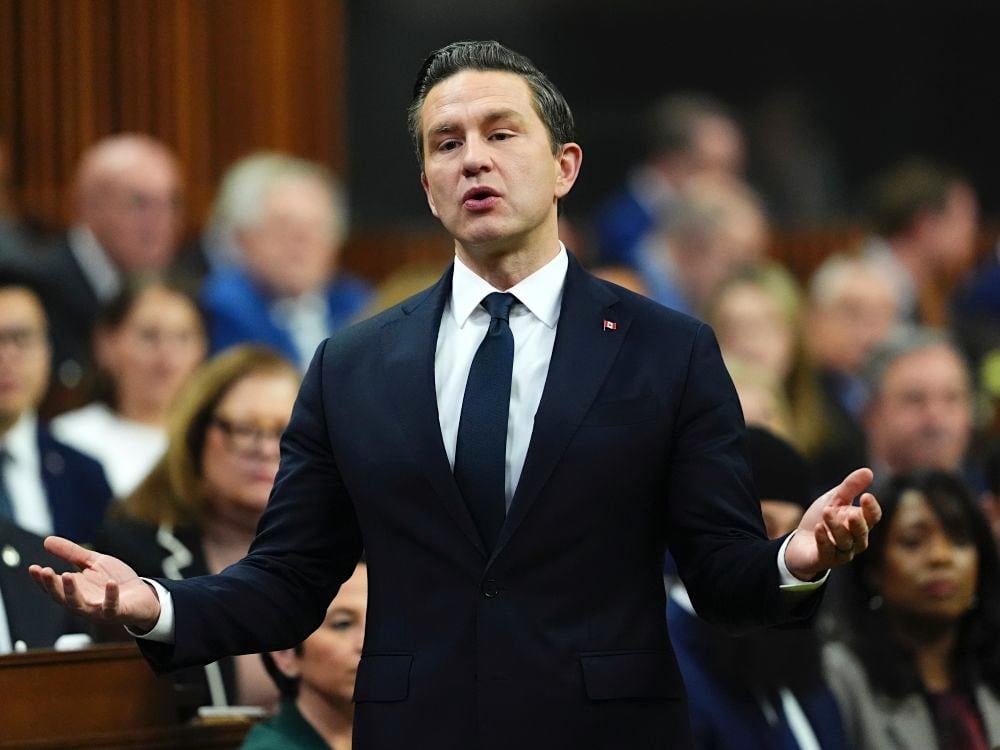 Conservative Leader Pierre Poilievre, says the author, deliberately misrepresented how the justice system works to score points. Photo by Sean Kilpatrick, the Canadian Press.
Listen to this article
7 min
Canadian politics has always had its share of spin. What feels newer, and far more corrosive, is the growing comfort some politicians now have with simply abandoning the facts altogether, particularly when courts or public institutions are involved. Misrepresentation is no longer an occasional lapse or rhetorical flourish. It has become a strategy that trades accuracy for outrage and treats public trust as collateral damage.
Announcements, Events & more from Tyee and select partners
Vancouver International Dance Festival Returns for Its 26th Season

This year’s event offers dance lovers a lineup that soothes, provokes, inspires and transforms.
Two social media posts earlier this month offered clear examples of how that strategy operates in practice. Different facts, different venues, but entirely the same modus operandi. In both cases, senior Conservative politicians took complex, legally constrained realities and recast them as scandal, grievance and institutional failure. The aim was not to clarify or persuade but to inflame, reinforcing a narrative that casts courts, universities and institutions as enemies rather than essential parts of a functioning democracy.
The first example is one I know well because I was there. I represented a man who splashed red paint on Ottawa’s National Holocaust Monument in protest of the unfolding humanitarian crisis in Gaza. It was a serious crime, and he pleaded guilty. The sentencing process was lengthy and exacting, involving extensive submissions, detailed community and victim impact statements, and a careful examination of motive and case law. The sentencing judge ultimately delivered one of the most careful and principled decisions I have read in years.
The result was not some caricature of Liberal soft-on-crime leniency. The offender was sentenced to five months in jail and two years of probation. By the time the sentence was imposed, this first-time offender had already spent more than 150 days in actual prison and months under extraordinarily restrictive bail conditions, including house arrest, GPS monitoring and effective exile from his children.
The judge emphasized denunciation, deterrence and the profound harm done to the Jewish community, while also explaining why the Crown had not met the very high burden of proving hate motivation beyond a reasonable doubt. The whole process was the rule of law doing precisely what it is designed to do.
Enter Pierre Poilievre. On X, he declared: “A man defaces Canada’s Holocaust Monument with blood-red paint and faces no real jail time. Under the Liberals, antisemitism is tolerated, excused, and waved away for political convenience.” More than half a million people saw the post. It was also false.
Poilievre did not attend the sentencing. He did not read the decision. He appears not to have read any reporting beyond what fit neatly into a prewritten script. The offender faced real jail time and served it. He was detained at bail. He spent months in custody at the Ottawa-Carleton Detention Centre. He was released only after pleading guilty and while subject to strict bail terms, which he complied with.
Billionaires Don’t Control Us
Get The Tyee’s free daily newsletter in your inbox.
Journalism for readers, not profits.
EmailSubscribe
Disagree with the sentence if you like; many do. But inventing facts to fuel grievance is something else entirely. For Poilievre, the newly reaffirmed leader of Canada’s Opposition party, everything becomes evidence of Liberal rot, everything is softness, and any inconvenient facts are ignored.

How Big Tech Spearheads the US Threat to Canadaread more
It is entirely legitimate to criticize court decisions. I do it all the time. It is more than legitimate to criticize the Liberal government; I do that all the time, too. What is unacceptable is for political leaders, who should be held to a higher standard than the rest of us, to deliberately misrepresent how the justice system works to score political points. That kind of misinformation corrodes trust in judges and courts and conditions the public to see every decision as partisan rather than principled. We do not need to look far south to see where that road leads.
If this pattern sounds familiar, it is because the same routine played out again, this time repackaged as a free-speech crisis. Conservative MP Garnett Genuis took to social media to announce that the student union had cancelled his event at York University in a “further attack on free speech.” The implication was obvious: politically motivated students were silencing conservative ideas. Genuis’s social media post travelled fast, as grievance narratives usually do.
Except that was not what happened. As CBC later reported, the event was not cancelled by the student union at all. The York University Student Centre declined it due to booking rules for the proposed open-area town-hall format. Genuis was told he could book a closed space for that kind of event. He chose not to. In other words, no one silenced him. He cancelled himself.

Why Poilievre and Carney Are Silent on Grok’s Child Sexual Abuseread more
That clarification arrived after the outrage had already done its work. Even fellow Conservatives swallowed the grievance whole. Michelle Rempel Garner publicly called for York University to be defunded. This is how political misinformation spreads: quickly, confidently and with just enough plausibility to avoid immediate correction. Free speech was not under attack. Student unions were not censoring debate. But the narrative was politically useful, so accuracy became expendable.
Taken together, these incidents are not accidents or isolated missteps. They are features of a broader strategy. Modern Conservative messaging increasingly relies on manufacturing grievance through selective facts, exaggeration and outright errors, confident that the truth will never travel as far or as fast as the original lie.
The justice system is imperfect. Universities are imperfect. Democracy, like any other system, is imperfect, but it depends on a shared commitment to reality. When politicians with power and privilege knowingly distort court decisions and invent free-speech panics to stoke resentment, they are not engaging in democratic debate. They are poisoning it.
Grievance-first politics may generate outrage, donations and viral posts. Still, it does so by eroding trust in the very institutions that allow a pluralistic society to function at all. At some point, we should stop pretending this is accidental. It is a strategy that prioritizes short-term political gain over the long-term health of Canadian democracy.
No comments:
Post a Comment